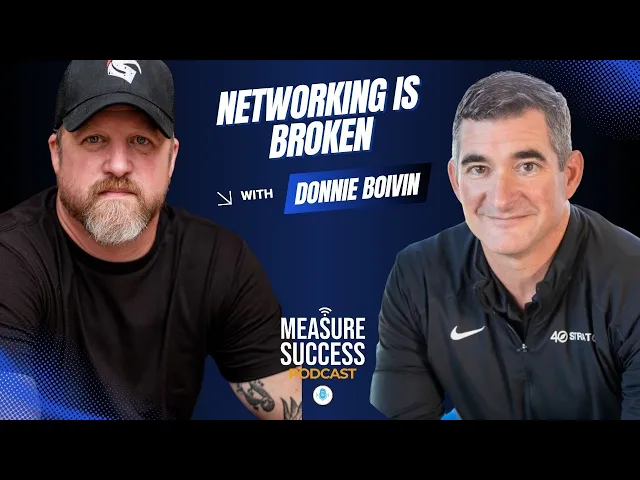
How To Build Relationships That Scale Business
Learn how to build networking systems that create referrals, relationships, and business growth with practical strategies from Donnie Boivin.


Words by
Carl J. Cox
Networking is one of the most misunderstood business activities. Many business owners attend events, join groups, collect business cards, and leave feeling productive. But weeks later, nothing changed. No clients. No revenue. No meaningful opportunities. In this episode of the Measure Success Podcast, I sat down with Donnie Boivin, founder of Success Champion Networking, to discuss why traditional networking often fails and what business owners should do differently.
Connect with Donnie:
LinkedIn https://www.linkedin.com/in/donnieboivin/
Facebook https://www.facebook.com/donnie.boivin
Instagram https://www.instagram.com/donnie.boivin/
Website https://successchampionnetworking.com/
Why Most Networking Fails
Many people approach networking as a social activity.
The problem?
Relationships alone do not create business growth.
According to Donnie, networking must function as a business development strategy.
That means asking:
• Is this activity creating ROI?
• Am I meeting the right people?
• Are these relationships opening doors?
• Am I investing time where it matters?
If not, something needs to change.
It Is Not Who You Know
One of the strongest messages from this conversation:
“It’s not who you know. It’s who knows you and brings your name up in the right conversations.”
This changes everything.
Many people focus on building large networks.
Successful business owners focus on building trusted networks.
The difference matters.
Stop Chasing Clients Directly
One mistake many business owners make:
Trying to meet every potential customer directly.
Instead, Donnie recommends identifying who already has relationships with your ideal clients.
Examples:
• Marketing agencies
• HR consultants
• Fractional executives
• Accountants
• Service providers
• Industry specialists
Ask:
Who already has access to the people I need to meet?
That question changes networking from random to strategic.
The Difference Between Referrals and Introductions
Many people treat referrals and introductions as the same thing.
They are not.
Introductions:
Two people meeting to explore opportunities.
Referrals:
An introduction with a sales conversation attached.
Why does this matter?
Because introductions are easier to create.
And over time, introductions often create stronger business relationships.
Build Your Starting Lineup
One concept from this conversation stands out.
Your starting lineup.
These are the people who:
• Open doors
• Mention your name
• Create opportunities
• Understand your business
• Bring value consistently
Many professionals spend time helping people who never reciprocate.
That creates frustration.
Strong networks create momentum.
The PACT Framework
Donnie shared his relationship framework:
Partner Up
Determine if someone belongs in your network.
Adjust
Review whether introductions and connections created value.
Combine
Look for opportunities to collaborate.
Track
Measure ROI from the relationship.
This creates intentional networking instead of accidental networking.
Why Reciprocity Matters
Relationships are not transactional.
But they should create value.
Strong relationships involve:
• Shared opportunities
• Mutual support
• Collaboration
• Consistent communication
People who continually take without giving rarely become long-term partners.
Discipline Creates Opportunity
One thing that stood out:
Consistency.
Networking systems work when people consistently:
• Build relationships
• Follow up
• Make introductions
• Add value
• Stay visible
Discipline compounds.
Final Thoughts
Networking should not feel like an obligation.
It should feel like a growth strategy.
The goal is not to know more people.
The goal is to build relationships with the right people.
Listen to the full episode and ask yourself:
Who is talking about your business when you are not in the room?


