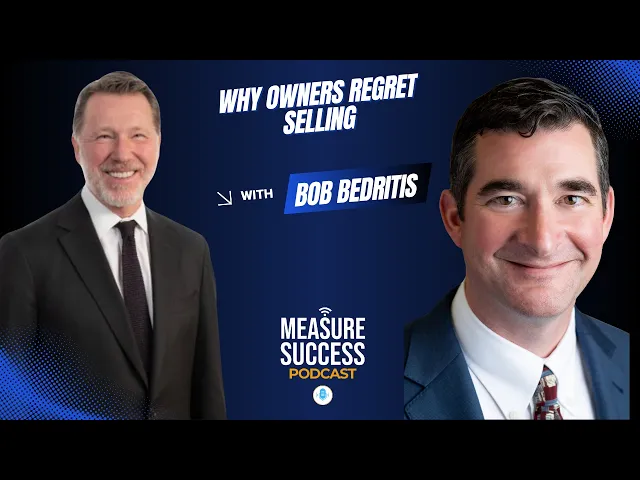
Why 75% of Business Owners Regret Selling
Bob Bedritis explains why 75% of business owners regret selling — and how exit planning, the wealth gap, and a strong third act change the outcome. Listen now.


Words by
Carl J. Cox
In this episode of the Measure Success Podcast, I sat down with Bob Bedritis, founder and managing director of Oswego Private Wealth Management and a certified exit planning advisor, to discuss why so many owners regret selling, the wealth gap that catches them off guard, and how to build an exit that actually leads somewhere. Bob spent more than two decades on Wall Street with Merrill Lynch and UBS before building a family-run firm that helps business owners become financially independent of their businesses.
Most business owners dream about the day they sell. The check clears. The pressure lifts. Freedom, finally. Then the regret sets in.
In this episode of the Measure Success Podcast, I sat down with Bob Bedritis, founder and managing director of Oswego Private Wealth Management and a certified exit planning advisor, to discuss why so many owners regret selling, the wealth gap that catches them off guard, and how to build an exit that actually leads somewhere. Bob spent more than two decades on Wall Street with Merrill Lynch and UBS before building a family-run firm that helps business owners become financially independent of their businesses.
The Wealth Gap Most Owners Never See
Most owners have a number in their head. Few have done the math behind it.
Bob calls the space between what you have and what you actually need your "wealth gap."
"It's close to 75% truly regret having sold their business."
The reason is almost always the same: the sale price and the retirement number are not the same thing. Owners anchor on the headline figure and never reverse-engineer what they truly need to live the life they want.
The Real Math of Selling a Business
Here is the part that blindsides people.
Say an owner needs $5M to retire, and sells the business for $5M.
• They often get only half in cash — around $2.5M
• The rest is seller financing, rolled equity, or earnouts
• Frequently they never collect all of it — sometimes none of it
• After tax, maybe $1.5M actually remains
That owner is still $3.5M short of their number.
And they've given away the very asset that was generating the income.
The lesson: know your wealth gap before you sign anything.
Exit Planning Is Really Growth Planning
Bob's core reframe changes the whole conversation.
"Exit planning is now — and what I mean by that actually is really growth planning."
Ideally it starts five years before the exit. Three at a minimum.
If a family needs $5M net and the business only sells for $5M gross, the real work is closing that gap — growing the business so the sale actually funds the life.
What gets in the way?
• Over-dependence on the owner
• Every major client and vendor tied to one relationship
• A business that can't run without the founder in the room
Tax strategy matters too — but you can't turn an LLC into an S-Corp the week before a letter of intent. These moves have to be made years in front.
Make Yourself Dispensable, Not Indispensable
The most counterintuitive line in the episode:
"A legitimate exit strategy is to never exit, but make yourself dispensable, not indispensable."
It starts with people you can trust to run the business. That takes time, wisdom, and a real process.
Bob's firm works in 90-day segments. Every quarter, they ask one question:
Keep or sell?
The answer might be "keep" for the next 20 years. But asking it consistently keeps the owner honest about what's best for them — not just what's comfortable.
The Three-Act Play of Life
Bob frames every owner's life as a three-act play.
• Act One: education, family, figuring out where you'll live and who you'll become
• Act Two: your career and the business you build
• Act Three: the transition of the business — and everything after
Too many owners treat the third act as an afterthought. That's why the regret runs so deep — their identity is wrapped around the axle of the company.
"That third act can be and should be the most exciting act of your play."
Not shooting pool at 10 a.m. with CNN on. Something to move toward — a cause, a craft, grandkids, a mission. As Bob put it, there has to be something to move toward, not just something to move away from.
Yes-And People vs. Yes-But People
Bob splits business owners into two camps.
He learned the distinction doing improv comedy to loosen up his Wall Street stiffness — you have to accept what your partner gives you and build on it.
"Where there's a will, there's a way."
He sees it play out geographically too. His Oregon clients often wake up bracing for the next regulation or tax hike. His Florida clients tend to lead with optimism. But the mindset, he argues, matters more than the ZIP code — and things run in cycles.
A Leader Who Leads, Not an Advisor Who Advises
Bob's differentiator is simple, and it's not asset allocation.
"I'm not an advisor who advises. I'm a leader who leads."
He doesn't wait for the client to call with a question. He gets in front of the decision and helps build the roadmap — then fights for the client to execute it. The second differentiator is the human element: someone who has seen success, failure, illness, and everything between, and brings all of it to the relationship.
Final Thoughts
This episode is about far more than selling a business.
It's about:
• The wealth gap and the real math of a sale
• Exit planning as growth planning
• Building a business that doesn't depend on you
• Designing a third act worth living
You can always make more money. You can't get the years back.
To learn more about Bob Bedritis and his team, visit OswegoPrivateWealthManagement.com.
You can also connect with Bob Bedritis on LinkedIn for more insights on exit planning and financial independence.
Listen to the full Measure Success Podcast episode today and continue building a strategy that helps you measure success the right way.


