Why 100 AI Leads Won't Save Your Business
Gal Borenstein shares why more AI leads won't grow your business, how small companies beat Goliath, and what replaces SEO on the Measure Success Podcast. Listen now.

Words by
Carl J. Cox
Every small business owner is being told the same thing. Add AI or fall behind.
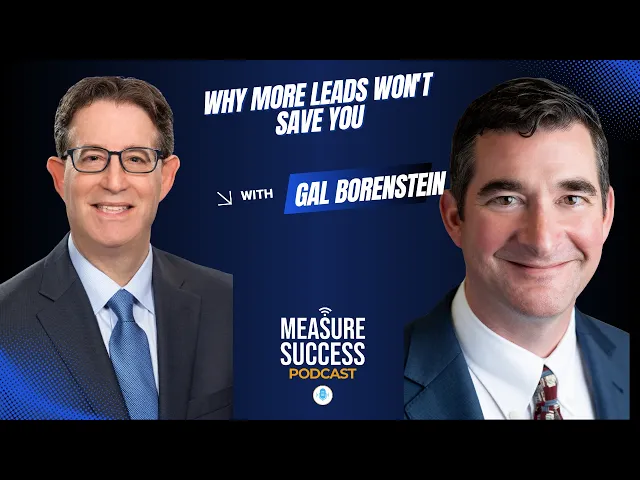
In this episode of the Measure Success Podcast, I sat down with Gal Borenstein, founder and CEO of The Borenstein Group and author of Beating Goliath with AI, to discuss why more leads won't grow your business, how smaller companies can out-position bigger competitors, and what it really takes to build trust in the age of AI search.
Every small business owner is being told the same thing.
Add AI or fall behind.
So they rush in. They spin up agents, generate leads, and flood their pipeline.
Then nothing gets better. It gets louder.
Gal has spent 30 years helping over 100 B2B and B2G organizations sharpen their positioning and turn complex capabilities into real market growth.
AI Has No Emotional IQ — Your Brand Does
AI is powerful. But it's still artificial.
It can speed-read your archives, run your market research, and draft a hundred emails before lunch.
What it can't do is feel anything.
"There's no way to make AI feel something."
That matters, because the one thing a small business owns that a robot never will is emotional IQ.
That's your brand.
A brand starts with a promise and gets delivered over the lifetime of the business.
AI can accelerate the soul of your company. It can't manufacture one.
The FOMO Trap
Most small business owners aren't rushing into AI because of strategy.
They're rushing in because they're scared.
Scared of being displaced. Replaced. Made irrelevant by bigger competitors.
So they overspend, asking the wrong questions and getting the wrong answers.
And when you force-multiply mediocrity, you don't win.
You just sound like everyone else — 100x faster.
"If you have no differentiation and you sound alike and look alike, you're just a cell in an Excel sheet."
Why 100 Leads Can Sink You
Here's the trap nobody warns you about.
You ask AI for leads. It delivers 100.
But you're a small team. You can't serve a hundred people today. Honestly, you don't want to.
Unqualified leads sitting in the same bucket don't create growth.
They create work — endless follow-up for people who were never going to buy.
Gal's point is simple:
The outcome has to match your business.
If closing five to ten clients grows your company, why chase a hundred you can't handle?
Start With One Question
Before AI, before marketing, before any campaign, answer this:
What do you do unlike your competitors?
If you can't answer it, that's your first assignment.
Do the real market research — AI is genuinely good at this part:
• Who are my actual competitors? • What keywords and value propositions are they using? • Where do I look like a copy of everyone else?
"If you're not unique, you don't have a valid proposition."
That valid proposition becomes your ICP — the profile of the customer worth chasing.
Listen From the Outside In
You can now test in ways that used to be impossible.
Forget A/B testing. With AI, you can run A-to-Z testing — a hundred scripts, a hundred variations, before you ever launch.
But the gold isn't in the data. It's in the story behind it.
"The data does not tell you the story. You need to have the story and then see how it matches up."
Within 90 days, interview your voice of customer — customers, prospects, and especially the people who didn't buy.
Lost proposals will tell you exactly why you're not winning.
You just have to put your ego aside and ask.
You No Longer Own Your Narrative
This is the part that stings.
"You don't own the narrative anymore. The narrative is owned by your digital footprint."
Glassdoor. TrustPilot. Reviews. Whatever people are saying when you're not in the room.
Perception becomes reality — and a Google search can return 1.2 billion results in a nanosecond and still be wrong.
If you don't own your digital footprint, someone else writes your story for you.
SEO Is Dead — Meet the Digital Slingshot
Traditional SEO, in the old five-keywords sense, is pretty much dead.
What matters now is visibility inside AI-driven search engines.
Buyers are abandoning classic search and asking AI directly. If your name isn't there, you don't exist.
So build the authority that AI engines learn from:
• Authority links and expert content • A clear description of what you actually do • Q&A that teaches the engines who you are
Gal calls this the digital slingshot.
"This is a digital slingshot. It does not cost a lot of money."
It's how David beats Goliath. Not with budget — with the right attitude and relentless, consistent content.
Measure Trust, Then Monetize It
Gal measures success with trust — through his Guardian TRUST Ecosystem.
First, benchmark from the inside out. Ask your own team, zero to ten: do you believe the promises we make?
Then benchmark from the outside in. Mystery-shop your own competitors. Read their reviews. Go through the whole buying experience.
The gap between what you believe inside and what the market experiences outside is the whole game.
"The disparity becomes the opportunity."
It's not about what works. It's about what doesn't work — relative to what you're already doing.
Final Thoughts
This episode isn't really about AI.
It's about staying human in a market that's automating fast.
AI is the tool. Your brand, your trust, and your differentiation are the engine.
The takeaways:
• AI amplifies whatever you already are — sameness included • More leads isn't growth; the right leads are • Differentiation comes before automation • Your digital footprint owns your narrative now • Trust, measured inside and out, is the real metric
The best time to be a small business might be right now — if you use AI to sharpen your brand instead of drowning it out.
To learn more about Gal Borenstein and The Borenstein Group, visit BorensteinGroup.com.
You can also connect with Gal on LinkedIn, where he commits to responding within four hours.
Listen to the full Measure Success Podcast episode today and continue building a strategy that helps you measure success the right way.


