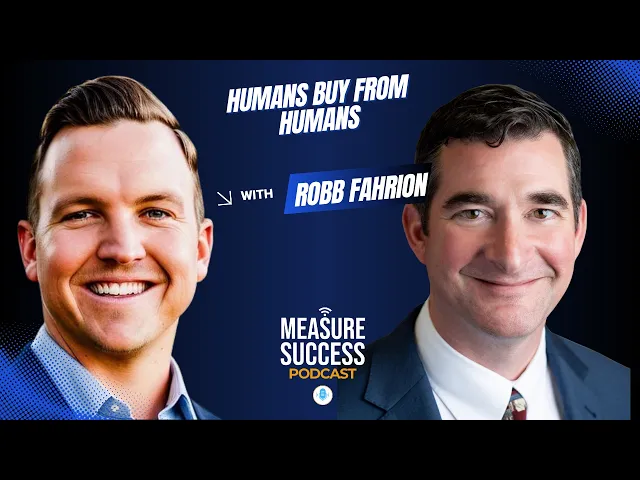
Humans Buy From Humans in the Age of AI
Robb Fahrion of Flying V Group shares how trust, video, and AI agents win in the age of AI slop on the Measure Success Podcast. Listen now.


Words by
Carl J. Cox
The internet is filling up with AI content. Blog after blog after blog. Some of it is even pretty good. But when nobody can tell what's real anymore, one thing gets more valuable, not less. Proof that you're a real human who actually knows the work.
In this episode of the Measure Success Podcast, I sat down with Robb Fahrion, Co-Founder and CEO of Flying V Group, to discuss why trust and authenticity win in the AI age, how AI broke traditional SEO, and why he signed a high-rent office lease when everyone else was going remote. Robb bootstrapped Flying V Group with his brother and best friend in 2016 and has grown it into a multi-million-dollar digital marketing agency in Newport Beach, California.
He Bet on an Office When Everyone Said Go Remote
In 2025, the easy move was obvious.
Drop the office. Save the money. Work from home.
Robb did the opposite.
He signed a lease on a high-rent office in Newport Beach and leaned into community.
Why? Because AI was accelerating so fast that he saw a different problem coming.
"When someone zigs, you zag."
With deep fakes and AI content everywhere, he believed people would crave what's real. A place to shake hands. Talk face to face. See that there are actual people behind the brand.
Everyone questioned it. Now the whole team agrees.
The office pulled people in like a gravitational force and turned into a collaborative, creative space, with a grand opening drawing upwards of 150 guests.
Why AI Broke Traditional SEO
For seven or eight years, Flying V Group lived on SEO and traditional inbound search.
Then ChatGPT, Claude, Perplexity, and Gemini flipped the apple cart.
Here's the catch Robb points out:
AI also let anyone, anywhere, produce high volumes of decent content.
The result is what Google calls scaled content abuse. Blog after blog after blog.
So the question buyers now ask changed.
"Who's the actual person behind the content?"
If it's not someone with the real experience, education, or background, people stop trusting the answer.
Authenticity and trust became the whole game.
Video Is the New Grounding Mechanism
Robb's answer to standing out in AI search comes down to proof.
Video content has become the number one way people actually get cited in generative engine optimization.
"How can we ground this result in reality?"
When AI can find a clip, validate that it's really you, and see your experience, that's a grounding mechanism. It pushes your result over a random blog post generated from a prompt.
For small businesses, he keeps it practical:
• Get on video and record 30 to 60 seconds of what you do
• Tell stories and share experiences an AI could never pull
• Use YouTube shorts, reels, and podcasts to have real conversations
"Humans buy from humans, people they like, people they trust."
AI can fake a blog post. It can't fake a lifetime of your experience.
Diving Head First Into AI Agents
Robb isn't anti-AI. Far from it.
His team has been hands-on-keyboard since ChatGPT launched, testing on their own business first, failing fast, then deploying what works for clients.
He sees a human-AI controlled environment, where people monitor the tasks agents run to accelerate the work.
A few ways they use it:
• Agents pull from APIs and flag red flags in client data daily, before a small ember becomes a wildfire
• Fathom AI takes notes on strategy calls, then an agent turns the transcript into a LinkedIn post and repurposed tweets
• Every insight stays rooted in a real conversation about a real problem
"Sales a lot of times is about speed and efficiency, and the first mover closes the deal."
How He Measures Client Success
Robb runs client work like an investment advisor.
You give an advisor $100,000. You expect to know where it went and what it returned.
He operates on the same principle. Meticulous data. Clean attribution. Every dollar tied out.
The critical early questions:
• What problem are we actually solving? Awareness, leads, revenue?
• What defines success, and what are the KPIs?
• Can we track it? Do we have the attribution to prove it?
He's clear that this is about long-term partnerships, not churn and burn.
With engagements at $5,000 to $10,000-plus per month, he can't afford to burn through clients every few months. The goal is building systems that run like machines over time, not one-off widgets.
Do the Little Things Better Than Anybody
Before business, Robb coached high school football, including at a small California school with a rare run of CIF championships.
He showed up expecting a secret sauce. What he found surprised him.
"They were doing the little things better than anybody."
Showing up on time. Foot behind the line on sprints. Keeping the playbook simple so kids didn't have to think, they just reacted and played fast.
He runs the business the same way.
• Consistent weekly meetings with real accountability, and a backup ready if someone can't make it
• Calling out a typo, not to embarrass anyone, but because it might be the difference when a prospect is deciding between you and someone else
• Wanting the employees who challenge him and tell him there's a problem
It compounds. Like bench press reps, you don't see the growth day to day. Six months later, the jump is undeniable.
How He Measures Success at Home
Robb welcomed his first baby girl last October, and he and his wife are going on three years married.
His definition of personal success is simple.
Intentional time with family, treated as seriously as the Monday operations call.
Every Sunday, he and his wife sit down and talk through the week. What's coming up. How they can help each other.
"Phone away, computer away, sitting in front of my wife, talking."
The discipline is staying accountable at home, not just at work.
The Book That Reshaped His Mindset
Robb's recommendation is an unexpected one.
Infinite Potential by Lothar Schaeffer, a quantum physicist.
It's a dense read. But it reframed how he thinks.
Your mindset and the energy you bring shape what you see and what your world becomes.
It's what lets him walk into a room and see what an empty office could be, then take the next step, and the next.
"A much healthier, more positive mindset, and a stronger belief in myself."
Final Thoughts
The through-line of this episode is trust.
AI made content infinite and cheap. That didn't lower the value of being real. It raised it.
Robb's whole approach comes back to the same idea, whether it's the office, the video strategy, the way he coaches his team, or the way he sits with his wife on Sundays:
• Show up as a real human
• Prove your experience instead of faking it
• Do the little things better than anybody
• Build trust for the long term
Listen to the full episode and ask yourself: In a world full of AI content, what makes your business unmistakably real? To learn more about Robb and his team, visit https://www.flyingvgroup.com/ or connect with him on LinkedIn.


