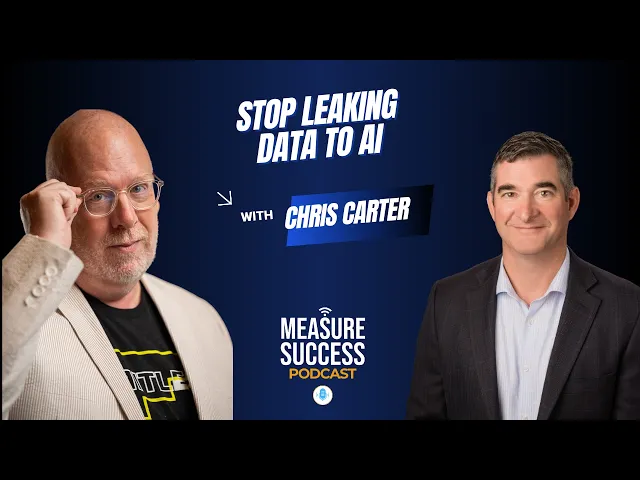
Stop Leaking Company Data Into ChatGPT
Chris Carter, CEO of Approyo, shares how a near data leak led him to build an AI safety tool, plus lessons on open vs. closed AI and measuring success. Listen now.


Words by
Carl J. Cox
Most people using AI at work have no idea what happens to the data they upload. They just want the answer faster. One employee learned that the hard way, and it almost cost his company everything.
In this episode of the Measure Success Podcast, I sat down with Chris Carter, Chairman and CEO of Approyo, a global technology company specializing in SAP and AI cloud infrastructure, to discuss the hidden dangers of AI data privacy and what business leaders need to understand before their teams get them in trouble.
Chris has authored 17 books, built and sold multiple businesses, and came out of retirement because, as he put it, he realized he could make a bigger difference back in the arena.
The 22-Tab Excel Document That Changed Everything
Chris was sitting at the end of a conference table with an SAP customer when one of the client's employees suddenly stopped mid-sentence.
He had been trying to upload a document into ChatGPT and couldn't get it to go through.
The file was a couple gigabytes. It had 22 tabs.
It contained every employee's 401k data for the entire corporation.
• Every social security number • Every account • Every percentage change by year • Every year of tenure
The employee had no idea what he was holding.
"They're ITAR compliant, they're PII data compliant, all out the window," Chris said.
The company's CFO and CIO had no idea it was happening either.
Why This Keeps Happening to Good People
Chris doesn't believe most people uploading sensitive data are careless or malicious.
He estimates 90% of people who make this mistake are good people trying to do their job quickly, not realizing what they're exposing.
The other 10%, he says, are the ones actively trying to cause harm, and they're usually easy to spot.
The real danger is the well-meaning employee who doesn't know what they don't know, especially when they're tired, busy, or under pressure from a deadline.
Building a Tool in 72 Hours
The incident stuck with Chris. He couldn't let it go.
At the airport, still thinking about it, he started talking through ideas out loud with Google Gemini through his earbuds while coding on his laptop.
Within about 72 hours, and barely any sleep, he had built a browser extension designed to catch people before they upload something they shouldn't.
He started with Google Chrome first, since it holds close to 69% of the browser market.
The third version is already live, less than six months after the idea started as one sleepless night in an airport lounge. It's now getting attention from VCs in California and New York.
"It stops you from doing dumb things for good people," Chris said. "Security is supposed to help you. It's not supposed to be the floodgate that says no, you can't go forward."
Open vs. Closed AI Systems
Chris broke down a distinction most non-technical users never think about: the difference between open and closed AI environments.
A closed system, or what Chris calls a "black box," only has access to your organization's own data and activities. It doesn't pull in information from competitors or the outside world.
An open system, like the default settings most people use on ChatGPT or similar tools, is learning from every interaction across the globe and can also expose your data to that same pool.
• Ask a basic recipe question: no real risk • Ask it to evaluate confidential employee data: instant risk
Most people never open their settings to change this.
"99% of the people don't go into the settings," Chris said. "And change it from open to closed to partial."
Why Comparing Yourself to Competitors Can Mislead You
Chris also warned about a subtler problem: using AI to benchmark against other companies, even in the same industry.
He described asking an AI tool what a retail company should expect for an upcoming season, only to realize the answer was shaped by data pulled from seven other retail organizations, each operating in different markets with different customers.
"Every organization I've seen, even if they're in the same thing, and even if they're right next door to each other, are different," Chris said.
Comparing and understanding the market is reasonable. Copying an answer without accounting for what makes your business unique is not.
The Three-Part Human, One-Part AI Framework
Chris and Carl discussed how they each approach using AI responsibly:
Three parts human expertise. One part AI.
• The human expert figures out the real problem • AI accelerates the work, whatever the tool • The human validates that the output is accurate • The human communicates the result to the business owner in plain terms
Chris compared it to trusting a surgeon: you wouldn't let someone perform surgery on you just because they read a summary online. The same discernment applies to AI-generated business decisions.
The AI Human Infinity Loop
Chris described his own mental model for AI use, which he calls the "AI human infinity."
It always starts with a human.
The human puts a question or a task into AI.
AI does its work.
Then the human brings it back, evaluates it, and asks follow-up questions:
• Where did you get this information? • Is there another option available? • Did you make this up to keep me happy?
"The human has always got to be the front and the back end of anything that comes from AI," Chris said.
He credited Jeff Woods' book, "The AI-Driven Leader," with shaping how he thinks about treating AI tools like a genuine two-way conversation rather than a vending machine for answers.
A Daily AI Habit Worth Copying
Asked what AI habit he'd recommend to listeners, Chris didn't hesitate.
He gets an AI briefing every morning at 5 a.m., covering what's on his schedule, what emails matter, and what needs his attention that day.
He talks to his AI tools the way he'd talk to a person, treating the relationship as a genuine back-and-forth rather than a search bar.
"I really took Jeff's book to heart," Chris said. "I'm constantly asking it questions to help better me and itself."
How Chris Measures Success
For Chris, success in business comes down to two things: happy customers and happy employees.
His organization has not had a single employee leave in more than four years.
"If our employees are happy, which is great because I don't have employees that leave the organization, that shows that I'm doing something right," he said.
In his personal life, success is even simpler: faith, family, and friends.
He and his wife pray every morning and night. He has an ongoing family group chat, 27 years running, where every morning starts with "good morning, girls, we love you" and every night ends the same way.
Chris also shared that his own childhood, which included his parents' divorce and roughly a year and a half of couch surfing across 11 different homes as a kid, shaped how intentional he is about making sure his own children always feel secure.
Final Thoughts
This episode covered a lot of ground:
• The real risk of uploading sensitive data into AI tools
• The difference between open and closed AI systems
• Why 90% of data leaks come from good people making innocent mistakes
• A practical framework for validating anything AI produces
• What actually measures success once the business metrics are set aside
Chris Carter's message is a simple one: AI is an incredible tool, but the human has to stay in the loop, on both ends, every time.
Listen to the full episode and ask yourself: what is your team uploading into AI right now that you'd never approve if you saw it first?
You can also connect with Chris Carter on LinkedIn, or learn more about his work in AI and SAP at Approyo.com.


