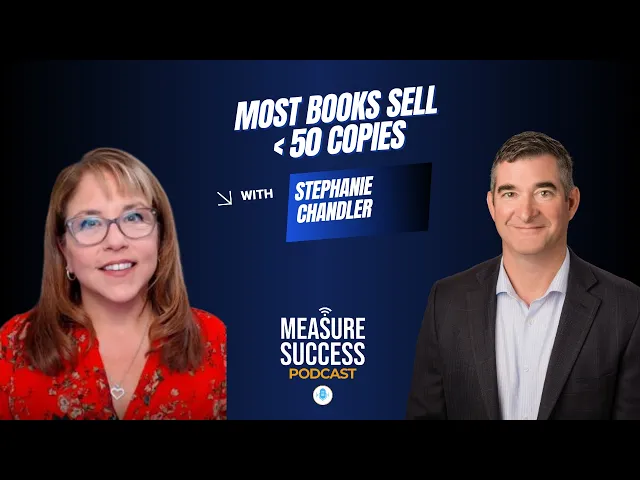
The Brutal Truth: Most Books Sell Less Than 50 Copies
Nonfiction Authors Association founder Stephanie Chandler shares the brutal truth about book sales, why AI shouldn't write your book, and how to turn a book into real business growth. Listen now.


Words by
Carl J. Cox
Most people think publishing a book is the hard part. Write it. Publish it. Done. It isn't. The average self-published book sells fewer than 50 copies, and most authors never see a single dollar of profit from book sales alone.
In this episode of the Measure Success Podcast, I sat down with Stephanie Chandler, founder of the Nonfiction Authors Association and author of The Nonfiction Book Marketing and Launch Plan, to talk about what really happens after you hit publish, why she won't let AI write a book for her, and how authors turn a book into an actual business asset.
A Casino Floor in Las Vegas
Stephanie's turning point didn't happen in an office.
She was in software sales during the dot-com boom, carrying a bottle of Maalox in her briefcase and taking swigs before client meetings.
On a work trip to Las Vegas, she sat down for a hand of blackjack with a client, took two sips of a cocktail, and blacked out on the casino floor.
Security and medical staff surrounded her. They thought they'd caught an "Ocean's Eleven" scam in progress.
"I don't have a lot of shame. When I think back, I just think it's funny at this point."
It took a year, and a diagnosed ulcer, before she finally quit.
From Failed Fiction Writer to Bookstore Owner
Stephanie didn't leave corporate life with a clear plan.
She opened a bookstore, intending to write novels in the back office.
Six weeks in, she realized she was a terrible fiction writer.
But her Silicon Valley friends, in awe that she'd left a six-figure career, kept telling her they wished they had the courage to do the same.
That question — could she help them? — became her first book: a business startup guide.
• She wrote it while running the bookstore
• Speaking and consulting followed
• She eventually sold the bookstore and launched a publishing company
"I built a career I love."
Strategic Planning Is a Hypothesis, Not a Fact
Stephanie and I talked about why plans never survive contact with reality.
She built a detailed business plan before quitting her job, but even the best plan takes constant twists and turns.
Her advice: always have a plan, but be willing to shift gears.
• Campaigns fail
• Courses don't fly
• Events fall flat
The businesses that survive are the ones that test, study the results, and pivot.
The Brutal Facts About Book Sales
This is where the conversation got uncomfortable, in a useful way.
• The average self-published book sells less than 50 copies
• As many as 3 million new books enter the Amazon marketplace every year
• Less than 1% of authors get real bookstore shelf space
• 70% of all book sales happen directly through Amazon
• Audiobooks are now the fastest-growing format in publishing, and print isn't going anywhere either
"Every new book is a drop in the Amazon Ocean."
Stephanie's point: the book being published isn't the finish line. It's the starting line. The real work — reaching your target audience — begins after launch.
Books Are a Marketing Tool, Not a Profit Center
One story stuck with both of us.
A member of Stephanie's community left an executive job, started a consulting business, wrote a book, and began mailing 50 copies a month to prospective clients.
Within a few months, his business took off.
Nobody was counting how many copies sold on Amazon at that point. The book had already done its job.
"I would never tell anyone to publish a book in pursuit of making a big profit."
Three Things That Consistently Work
Stephanie shared three tactics she sees work again and again for authors trying to grow a business:
1. Your Community of Influence
Who do you know? Not just industry peers and past clients — the neighbor, the person you coach softball with, the classmate from 30 years ago.
80% of people want to write a book. Roughly 1% actually do. The people who know you will want to support that.
2. Podcast Interviews
Stephanie does them constantly, even without a new book to promote. She submitted guest applications the same morning we recorded this episode.
3. Amazon Ads
A pay-per-click program that works well for nonfiction and doesn't eat up personal time the way podcast appearances do.
Don't Let AI Write Your Book
We couldn't skip this topic.
Stephanie uses AI every day in her business — for brainstorming, sales copy, outlining, and editing. She's a self-described "huge Grammarly fan."
But she draws a hard line at letting AI write the book itself.
"I am a part of that Anthropic lawsuit — one of my books got put into training AI. So some of my concepts could end up in your book, and you don't even know it."
Her bigger concern: authenticity. A book is long enough that if AI wrote it, the risk isn't just plagiarism — it's that the finished product simply won't sound like you.
"That's the worst thing that can happen, is when you produce something and it's not you."
Her recommended workflow, AI or not:
• Record a talk you've already given and turn it into a chapter
• Take a walk and record your book out loud
• Hire a ghostwriter or developmental editor to shape the raw material
• Use AI for research and organization, not final prose — and use a tool that cites its sources, since chatbots can hallucinate facts
Final Thoughts
This episode covered more ground than book marketing alone:
• A health scare that forced a career change
• Building a business around a mission, not just a product
• The real numbers behind self-publishing
• Why community and consistency beat algorithms every time
• Where AI helps, and where it can quietly work against you
Stephanie's message is a version of something we talk about often on this show: the plan is a hypothesis, and the real value comes from what you do with it after launch.
Listen to the full episode and ask yourself:
Who in your community of influence would support you today if you just asked them?


