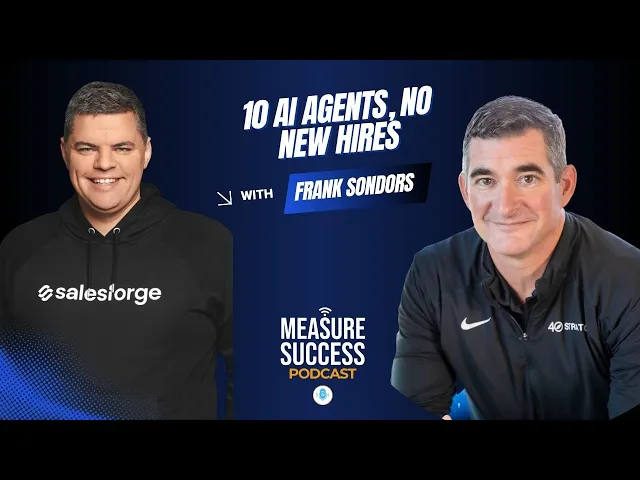
10 AI Agents, One Sales Team: Scaling Without New Hires
Salesforge CEO Frank Sondors explains how his company scaled with 10 AI agents and nearly flat headcount, and why top sales reps who skip AI tools are falling behind. Listen now.

Words by
Carl J. Cox
Most sales leaders think the answer to growth is more headcount. More SDRs. More AEs. More bodies to build pipeline. Frank Sondors built a $3M-in-year-one company betting against that idea.
In this episode of the Measure Success Podcast, I sat down with Frank Sondors, co-founder and CEO of Salesforge, to discuss how his company scaled revenue while keeping headcount nearly flat, why 60% of any sales team is what he calls "dead wood," and what's actually breaking outbound sales today. Frank spent a decade in B2B sales, including running a 50-person sales team as VP of Sales, before starting Salesforge three years ago with two co-founders he met through a YC matchmaking platform.
From Zero to $3M in Year One
Frank and his two co-founders started Salesforge in Vilnius, Lithuania, after meeting through a YC matchmaking event.
In the first year, the three of them took the company to $3M in revenue. No sales team. No support team. Just the founders and the product.
Today, Salesforge runs seven products under what Frank calls the "software compound model" — the same approach HubSpot, Salesforce, and Apple use, where one customer buys multiple products instead of just one.
"That's how you grow a company," Frank said.
The 20/20/60 Breakdown of Any Sales Team
Frank's view of a typical sales org:
• 20% are naturals — fully autonomous, don't need tooling • 20% are "sponges" — can grow close to A-player performance with the right tools • 60% are what he bluntly calls dead wood
That last group isn't a training problem, in his view. It's just how sales talent is distributed.
But the tooling conversation matters more for the top 40% than people assume.
Why A Players Are Becoming B Players
This was the sharpest point in the conversation.
"Even though they are an A player, maybe today became a B player. And the reason why they became a B player is because they said no to all the tooling that's out there."
Frank's argument: the top reps who won't touch AI tools are still good at closing. But they're not getting as many opportunities to close, because they're slower at everything upstream.
He calls the reps who do adopt these tools "AI native employees" — and says it's increasingly a factor in who he hires. If a candidate can't tell him they'd use Claude or ChatGPT to solve a work problem, he sees it as a values mismatch with the company.
10 AI Agents, Flat Headcount
Salesforge has 50 employees. But Frank is more interested in a different number: 10 AI agents running in the go-to-market department alone.
That includes an inbound agent handling calls, SMS, and WhatsApp, and "Agent Frank" — an outbound AI SDR modeled after Frank himself, rolled out two years ago.
"The most successful companies — you typically see that the revenue, the run rate essentially is going up every single month, but the headcount is very, very flat."
The mechanism: instead of hiring more people to build pipeline, the software takes on more of the legwork.
How the Tool Actually Works
Frank broke down where Salesforge fits in the sales process — prospecting, nurturing, and closing.
The company's job, in his words, is getting a prospect "from a zero to a meeting." That starts with a data aggregator pulling from 20+ databases — what Frank calls a "data waterfall" — covering over half a billion people.
From there:
• The system stores what you're selling and the pain points you solve • A knowledge base holds your sales playbook, pricing, and FAQs • Replies get generated in seconds instead of the 10–20 minutes a rep used to spend writing them by hand • Every conversation feeds an "evergreen learning mechanism" that makes future messaging better
"If the value of the software doesn't increase over time, then it's not actually a good software to buy."
The CRM the Company Barely Uses
One of the more candid moments: Frank admitted Salesforge went a year and a half without a CRM at all.
Even now, with HubSpot in place, he says he barely logs into it himself.
Why keep it? Because most salespeople are used to a CRM, and switching that habit is hard.
"The dilemma that I face is what I call the human dilemma. People are just used to using a CRM."
The Email Deliverability Problem Nobody Talks About
Frank flagged this as one of the biggest hidden risks in outbound today.
Sending high volumes of email from a primary business domain puts that domain at risk of spam reports and blacklisting. His fix: secondary "outreach domains" that protect the main domain if something goes wrong.
He shared a real example — a top-10 customer whose emails all started landing in spam. The cause turned out to be the phone number in their email signature, which had been flagged as a spam signal.
"Sending emails to the right people, super important. Then yeah, you need this email infrastructure, but then you also need to think about the copy."
His takeaway: running outbound today requires being something close to a domain expert — not unlike running paid ads.
Final Thoughts
The through-line of this conversation: AI isn't replacing good salespeople. It's widening the gap between reps who use it and reps who don't.
Frank's own experience — three co-founders, no sales team, $3M in year one — is the extreme version of a trend playing out everywhere.
The companies growing fastest right now aren't the ones hiring the most people. They're the ones building systems that get smarter with every conversation.
Listen to the full episode and ask yourself: Are you still using the same sales methods you were using in 2022, or have you adapted to what's actually working now?
To learn more about Frank and Salesforge, visit https://www.salesforge.ai. You can also connect with him on LinkedIn for more on AI-driven sales.