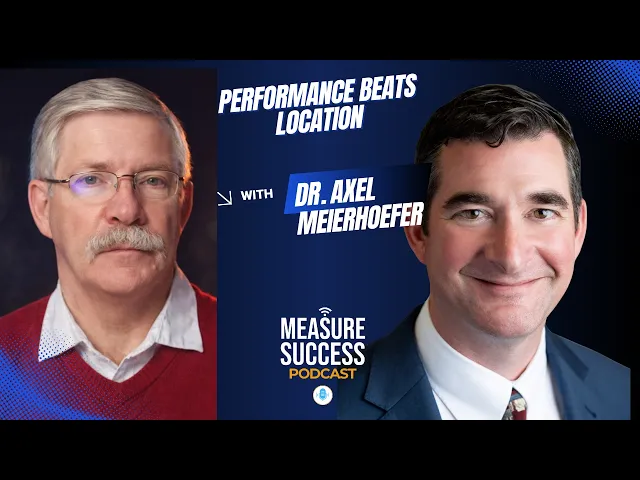
Real Estate Wealth: Performance Beats Location
Former fighter pilot Dr. Axel Meierhoefer shares how performance-based real estate, turnkey systems, and the IDEAL framework build financial independence. Listen now.

Words by
Carl J. Cox
Most people invest for retirement and hope it works out. They put money in a 401(k). They trust the market. And they assume it will be enough. But what happens if it isn't?
In this episode of the Measure Success Podcast, I sat down with Dr. Axel Meierhoefer, former German Air Force fighter pilot and founder of Ideal Wealth Grower, to discuss how to build real estate wealth that creates true financial independence. He's also an author. Axel came to the United States through the military, built a career in software, and then set out to solve one problem for himself: how to stop trading time for money and start owning assets that pay him instead.
Why He Chose Real Estate
Axel grew up in a system where retirement was someone else's job.
In Germany, he explained, most people assume the government pension will take care of them.
In the U.S., he saw something different — a culture of self-reliance.
"If I want to have a good retirement, I have to do something for that."
When he started his own business, the 401(k) contributions stopped. So he went looking for an asset he could control. He landed on the base of Maslow's pyramid: shelter, food, and security. He had handled security for 22 years in the military. He could grow food. So he studied shelter — and real estate became the path.
Performance Beats Location
Everyone repeats the same rule: location, location, location.
Axel pushes back.
"That's secondary. It's not irrelevant, but it's secondary to performance, performance, performance."
When you invest for cash flow, the question is not "Is this a prestigious address?"
It's "How much does this property pay me back relative to what it costs?"
That single shift is why he invests where the numbers work — often far from the expensive coasts — instead of where the postcard looks nice.
The Scaling Math
Here is the point that reframes everything.
$100,000 in stocks buys you $100,000 in stocks.
$100,000 as a down payment can control roughly $500,000 in real estate — two or three houses.
Same money. Five times the asset base on day one.
Add depreciation, and the gap widens. On two $275,000 homes, Axel noted, you can write off around $20,000 a year for 27.5 years.
"They're going to laugh at you if you ask what you can write off for your stock investment."
The IDEAL Framework
Axel's company name is also his method. IDEAL stands for:
• Income
• Depreciation
• Equity
• Appreciation
• Leverage
Together, these are what make real estate scalable in a way most assets are not. Bought right, a property produces positive cash flow after interest, principal, insurance, property tax, and management — with a couple hundred dollars per property left over.
Turnkey Providers and Clusters
To invest without buying himself a second job, Axel works with turnkey providers.
A turnkey provider brings three things under one roof:
• A construction and renovation division
• A real estate agency
• A professional property management division
Because you buy from the same company that manages the property, you can negotiate a one-year warranty. Whatever new-construction issues surface in year one get fixed at no cost — while your reserves build.
He also builds clusters: four to six to eight properties in one market, like Northern Alabama.
"As a group, we're like a little mini elephant of 20 or so properties."
That collective size gives his clients real weight when they need the provider's attention.
Invest Like a Business Owner
One of Axel's strongest themes is mindset.
"You are in charge."
He tells clients to professionalize — start an LLC, open the bank account, and show up as a business owner.
Banks, insurers, and agents are all businesses looking for clients. When you approach them as an owner offering opportunity — "Who wants to give me the best deal?" — the whole dynamic changes.
He also frames property management as the "bad cop" in a healthy triangle between owner, tenant, and manager. That lets you stay the gracious owner while someone else enforces the rules.
Build Reserves, Then Repeat
The "grower" in Ideal Wealth Grower starts with a G: goal.
If the goal is a growing portfolio, not spending every dollar of cash flow, then the discipline is simple:
• Set aside 10–15% of cash flow for reserves
• Add at least 10% of income into an accumulation account
• Park it in a high-yield savings account earning 3–4%
Do that, and roughly every 12–18 months you can buy another property.
Trust, But Verify
The hardest lesson came from experience.
"You have to trust but verify."
You don't need to inspect every house in person. But combining a business trip with a property visit, shaking hands with your property managers, and building a real relationship changes how you're treated.
Axel's other regret: waiting too long to start, and being slow to study new opportunities like Bitcoin.
"Plant a tree today. The best time was 20, 30, 50 years ago."
How AI Changed His Research
Axel now uses AI the way he once used a stack of separate tools.
Where he used to pay for a rent comparison tool, a school-rating tool, and county economic data separately, he can now explore all of it in one conversation — "like peeling an onion," moving from a market's economy to school districts to construction permits.
He's even named his ChatGPT "Roberto."
Final Thoughts
Axel's definition of success is clear.
It's the Time Freedom Point — the moment you live from the performance of your assets and no longer depend on anyone else.
The path there isn't glamorous. It's performance over prestige. Systems over guesswork. Reserves over consumption. And starting today instead of someday.
To learn more about Dr. Axel Meierhoefer and his approach, visit idealwealthgrower.com. You can also connect with Axel on LinkedIn for more on building wealth through real estate.
Listen to the full Measure Success Podcast episode today and continue building a strategy that helps you measure success the right way.


