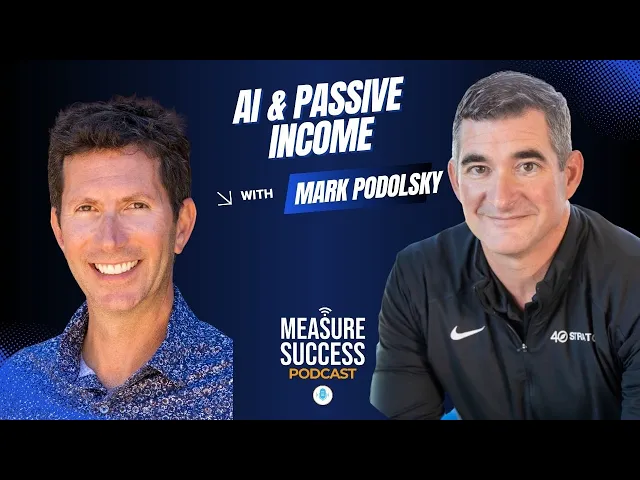
Passive Income, AI, and Purpose with Mark Podolsky
Discover how passive income, AI, and purpose work together to create lasting success. Carl J Cox and Mark Podolsky share practical lessons for entrepreneurs and leaders.

Words by
Carl J. Cox
What does success look like after financial freedom?
Most entrepreneurs spend years working toward financial success. They build businesses, grow revenue, hire teams, and create opportunities. But what happens after they reach those goals? For many leaders, the next challenge isn't making more money, it's finding greater purpose.
In this episode of the Measure Success Podcast, Carl sits down with Mark Podolsky, known as The Land Geek, to discuss passive income, artificial intelligence, entrepreneurship, and what success really looks like after you've achieved financial freedom.
Their conversation blends practical business advice with personal reflection, offering lessons for entrepreneurs, executives, and business owners who want to build organizations that create both wealth and meaning.
From Investment Banking to Land Investing
Mark didn't begin his career in real estate.
He spent years working in investment banking, helping companies through mergers and acquisitions. While the career provided financial opportunities, it also demanded long hours and constant pressure.
Everything changed when he discovered land investing.
Instead of focusing on traditional real estate, Mark built a business around buying and selling raw land while creating recurring income through seller financing. Over time, that business gave him something many entrepreneurs chase—both financial freedom and time freedom.
Today, he has completed thousands of land transactions while helping others learn the same principles.
Why Passive Income Matters
Passive income isn't about getting rich overnight.
It's about creating choices.
When income isn't tied to every hour you work, you gain flexibility. You have more time to spend with family, invest in your business, travel, volunteer, or simply think more strategically.
Carl points out that many professionals solve their money problem but never solve their time problem.
Building systems that generate recurring income changes that equation.
Systems Create Freedom
One of the biggest themes throughout the episode is the importance of systems.
Businesses cannot continue to grow if everything depends on one person.
Documented processes, automation, delegation, and repeatable workflows allow organizations to scale while maintaining quality.
The goal isn't simply efficiency.
The goal is creating space for leadership, innovation, and better decision-making.
AI Is Becoming an Operating System
Artificial intelligence continues to reshape how organizations work.
Mark, author of Dirt Rich, believes many leaders still see AI as another software application.
Instead, he argues that AI should become part of your operating system.
Throughout the conversation, he shares examples of AI assistants helping manage calendars, review subscriptions, organize information, support research, draft communications, and automate routine work.
The result isn't replacing people.
It's allowing people to focus on higher-value work.
Carl reinforces an important point throughout the discussion.
Technology should create measurable value.
If AI saves time, reduces costs, improves decision-making, or helps your team focus on more important work, it's delivering a return.
If it doesn't, it's simply another tool creating more noise.
Solve Real Problems First
Many organizations jump into AI without a clear objective.
Mark recommends starting with one question:
What business problem are we trying to solve?
Instead of experimenting with dozens of disconnected tools, successful organizations identify one challenge, improve it, and build from there.
That approach creates momentum and long-term success.
The Second Mountain
One of the most meaningful parts of the conversation centers on what Mark calls the "second mountain."
The first mountain is achievement.
Building a career.
Growing a business.
Making money.
Reaching financial goals.
Many people eventually discover those accomplishments don't create lasting fulfillment.
The second mountain is different.
It's about purpose.
Relationships.
Faith.
Community.
Legacy.
Those become the measurements that matter most over time.
Success Beyond Revenue
Revenue matters.
Profit matters.
Growth matters.
But Carl reminds listeners that success should also be measured by impact.
Are you helping people?
Are you building something meaningful?
Are your relationships growing stronger?
Are you creating opportunities for others?
Those questions become increasingly important as businesses mature.
Being Present
One lesson stands out throughout the conversation.
Success means very little if you aren't present for the people who matter most.
Mark shares personal stories about learning to separate work from relationships and recognizing how easy it is for achievement to become a distraction.
His advice is simple.
Protect your relationships.
Business should support your life—not replace it.
Leadership Lessons from This Episode
Create systems before adding complexity.
Build recurring income whenever possible.
Use AI to solve meaningful business problems.
Protect your time with intention.
Invest in relationships before transactions.
Keep learning regardless of your level of success.
Measure success by both financial results and personal impact.
Final Thoughts
Success is not a destination.
It's a journey that evolves over time.
Financial freedom creates opportunity.
Purpose creates fulfillment.
This conversation with Mark Podolsky reminds us that the best businesses don't just create wealth—they create time, stronger relationships, meaningful work, and lasting impact.
Whether you're an entrepreneur, executive, business owner, or someone looking for your next level of growth, this episode will challenge you to think differently about leadership, AI, passive income, and what it truly means to measure success.
Listen to the full episode and ask yourself one simple question:
How are you measuring your success today?