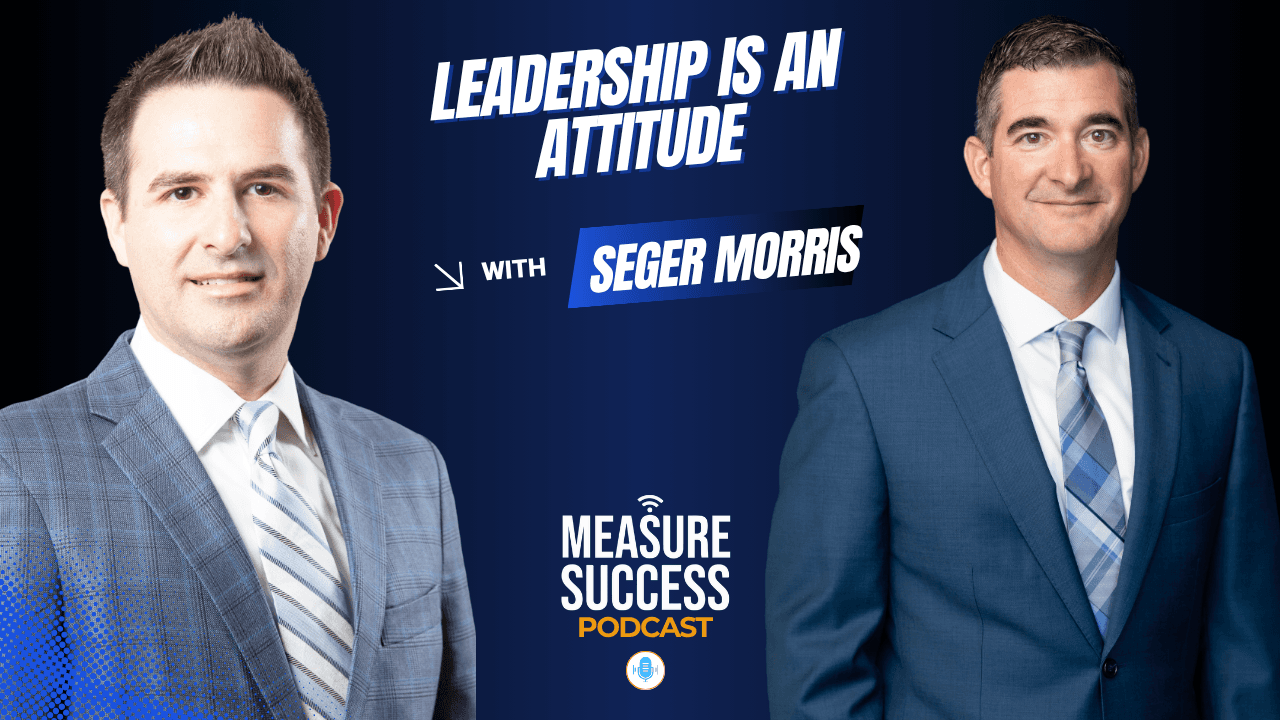
Leadership Is an Attitude, Not a Position
Dr. Seger Morris on leadership as an attitude, escaping the experience bias, and how AI empowers early-career leaders. Measure Success Podcast. Listen now.

Words by
Carl J. Cox
Most people wait to be given permission to lead. They wait for the title. They wait for the promotion. They wait for someone to say they've put in enough years. And while they wait, the chance to make an impact passes them by.
In this episode of the Measure Success Podcast, I sat down with Dr. Seger Morris, DO, MBA, osteopathic physician, healthcare executive, and nationally recognized leader in medical education and physician leadership, to discuss his new book, Let Me Lead, and why the biggest thing holding young professionals back isn't a lack of experience. It's the belief that they have to wait for it.
Seger was one of the first dozen guests on this podcast, back in early 2020, and one of 40 Strategy's first three clients. Watching his career grow since then has been one of the joys of this show.
Leadership Is an Attitude, Not a Position
Seger's message starts with a quote he heard years ago:
"Leadership is an attitude, not a position."
Most young professionals chase the title first. Partner. Director. CEO.
But when you slow down and ask why you want it, the answer often comes back to impact.
And impact doesn't require positional authority.
If you carry the attitude that you can influence the people around you every single day, you're already leading. The title just formalizes it later.
The Cry Behind "Let Me Lead"
The book's title came straight from a chapter Seger wrote.
It captures a frustration he hears constantly from younger professionals:
"I want my turn. I want my chance. Let me lead."
That desire isn't impatience. It's ambition looking for an outlet.
The question for every organization is whether it gives that ambition somewhere to go — or makes it wait a decade for no good reason.
You Don't Have to Wait 10 Years
Job descriptions love a number: "Must have 10 years of experience."
Seger's response is simple.
Ten years doing what?
He points out that the founders of many billion-dollar companies cluster around 30 years old. Nobody asks them for 25 years of experience first.
For work that depends on rules, compliance, and governance, experience compounds and matters. But for creativity, innovation, and new ideas, more years aren't the qualification we pretend they are.
This is the "experience bias" his book is built to break.
Learning Isn't Limited to Your Boss
One of the most practical parts of the conversation was for anyone stuck under a manager who isn't mentoring them.
Seger's take: you are not limited to that person.
• Books • Webinars • Online courses • YouTube
The resources to learn your industry are unlimited, and often free.
You can still learn from what other people have done — it just won't always come through a one-to-one relationship.
And if you consistently feel you could do your boss's job better — not arrogantly, but honestly — that's a signal. It may be time to earn that role, or to look elsewhere.
Courage, Confidence, and the Case for Risk
Seger and Carl dug into why some of the smartest people take the fewest risks.
The A+ student learns to play by the rules and follow the process. The C+ student figures they've got nothing to lose, so they take the shot.
Physicians, Seger notes, are almost always A+ students. Brilliant, talented — and deeply risk-averse.
Part of the reason is the oath itself.
"First, do no harm."
That instinct is essential at the bedside. But carried into business and innovation, it can be crippling.
Seger draws a line worth remembering:
"There's a difference between courage and confidence."
Courage is acting before you know the outcome. Confidence is what you earn by doing it over and over.
You don't wait for confidence to act. You act, and confidence follows.
Fluid vs. Crystallized Intelligence
Seger framed the generational tension through two kinds of intelligence.
Crystallized intelligence is accumulated knowledge — rules, processes, policies. It builds with age.
Fluid intelligence is creativity, idea generation, and problem-solving. It tends to peak earlier.
Youth brings innovation. Age brings the guardrails.
Neither is right or wrong. But the culture of an organization is shaped by who you put in your most senior seats — and whether you make room for the fluid thinkers to actually contribute.
Physician 3.0: When Information Becomes Free
Seger teaches a model he calls Physician 3.0.
• Physician 1.0 was the wise philosopher of the community, back in the days of Hippocrates. • Physician 2.0 was the walking encyclopedia of the Osler era — the gray-haired expert who knew everything. • Physician 3.0 lives in a world where no one can know everything. Cardiology alone publishes thousands of studies a year.
Here's why it matters far beyond medicine:
"It's no longer who has all of this information up here. It's who can access the information most efficiently and know the setting to apply it."
AI is accelerating this. It compresses crystallized knowledge faster than it touches fluid, creative thinking — which means it empowers people earlier in their careers to make a bigger impact, sooner.
What's left for the human? Connection. Judgment. Knowing your blind spots. Knowing when the AI is hallucinating.
Go Big or Go Home: The Decision That Doubled a Program
Asked about the biggest decision he's made, Seger pointed to starting a residency program.
The initial plan called for six resident physicians per year. But a neighboring hospital — smaller, with fewer resources — had just been approved for twelve.
Seger looked at it and saw no reason his program couldn't do the same.
So he made the call: twelve, twelve, twelve instead of six, six, six.
Go big or go home.
That program got its accreditation. And even though Seger has moved on, it still produces twice as many physicians every year — on a far more stable financial footing — than it otherwise would have.
Where Leaders Waste the Most Time
Seger's answer was direct:
"Leaders waste the most time obsessing over policies and processes that have always been — rather than asking the question of why is this this way, and can we change it."
The lesson he learned the hard way pairs with it: don't deviate from those policies until you've asked the right people the right questions, in the right way, with a sincere desire to make things better for the organization.
Challenge the process. Just do it with respect and intent, not recklessness.
Your Job Is to Be a Resource, Not "People"
Seger closed on a framework: people, processes, and resources.
The biggest mistake leaders in positional authority make is thinking of themselves as sitting in the "people" bucket.
"Your job is not to be people. Your job is to be a resource for other people."
When you see yourself that way, you stop chasing the image of being a CEO and start chasing the feeling of impact — empowering others to innovate, to standardize, and to succeed.
Final Thoughts
This episode is a permission slip for anyone waiting their turn.
It covered: • Leadership as attitude, not title • Escaping the experience bias • Calculated risk and the courage to act • Fluid vs. crystallized intelligence • How AI empowers early-career professionals • Leading as a resource for others
To learn more about Dr. Seger Morris and his book, visit segermorris.com. Let Me Lead releases September 1, 2026, wherever books are sold.
You can also connect with Seger on LinkedIn for more on physician leadership and developing the next generation of leaders.
Listen to the full Measure Success Podcast episode today and continue building a strategy that helps you measure success the right way.


