De-Risk Your Business Before You Sell It
Most owners think the hard part of selling a business is finding a buyer. It isn't. The hard part is being ready before the buyer ever looks.


Words by
Carl J. Cox
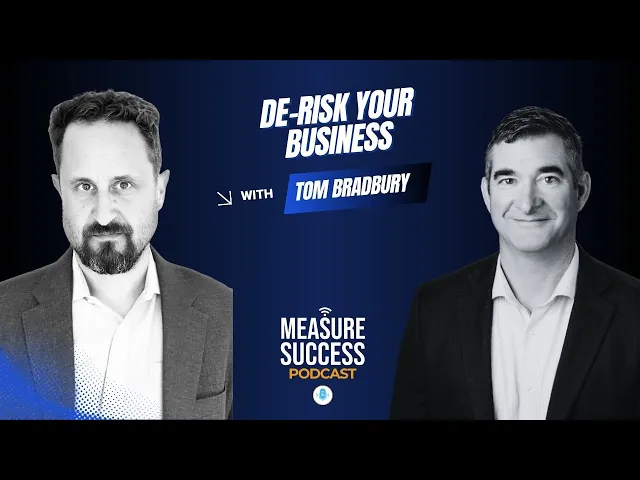
In this episode of the Measure Success Podcast, I sat down with Tom Bradbury, founder and CEO of Broad-Gauge, an execution risk intelligence platform. Tom spent 25+ years at the nexus of technology, workplace, and workforce transformation before building a third-party data subscription that gives PE-backed CEOs, sponsors, and investors an objective read on execution risk — before it reaches the P&L. We talked about preparing for an exit, the earliest warning sign leaders ignore, and how a question from his teenage son reshaped his entire company.
In this episode of the Measure Success Podcast, I sat down with Tom Bradbury, founder and CEO of Broad-Gauge, an execution risk intelligence platform. Tom spent 25+ years at the nexus of technology, workplace, and workforce transformation before building a third-party data subscription that gives PE-backed CEOs, sponsors, and investors an objective read on execution risk — before it reaches the P&L. We talked about preparing for an exit, the earliest warning sign leaders ignore, and how a question from his teenage son reshaped his entire company.
The Question From a 15-Year-Old That Changed Everything
Tom listens to his kids. Even about his business.
One day his then-15-year-old son said, carefully, "I want to tell you something, but don't get mad."
Then: "I think what you're doing has a little bit of a ceiling."
His son had watched how Tom used AI to interpret survey data and pushed him further.
"You always tell me, don't be using AI like it's Google on steroids."
That conversation became the impetus to take a methodology Tom had built over years and operationalize it with AI — analyzing the critical documents in the private equity deal lifecycle and surfacing execution risk inside them.
The ceiling his son spotted became the doorway to the company Tom runs today.
Interview Your Kids About You
Years earlier, an executive coach gave Tom unusual homework: interview his children about what it was like to experience him as a father.
He calls it life-altering.
He learned he often asked his kids to do things without explaining why. When his older daughter pointed it out — "Why didn't you just tell her why?" — it hit like a two-by-four.
The lesson traveled straight into his work.
"If I'm being a jerk to my kids, chances are I'm being a jerk in a similar way to someone I'm working with."
How you carry yourself at home is usually how you carry yourself everywhere.
Don't Lose Your Soul Chasing the Exit
We build businesses to create value. But the pot of gold doesn't matter if the relationships closest to you fall apart along the way.
Tom and I both have four kids. Neither of us has been a perfect husband or father while chasing the work.
"It's easy to lose context of what matters."
The goal is to crush your company's value and get the best exit possible — without losing yourself in the process.
Get Ready Before You Hire the Banker
Here's a take investment bankers may not love: get your business ready before you hire one, rather than counting on them to clean you up.
Tom agreed completely.
Most buyers today are private equity firms, and selling means answering to a sponsor's cadence and accountability in a way an owner-operator never had to.
Bankers also represent you best when they see you at your best.
"They're looking at a person who's ready for the prom."
You don't have to be perfect. Get to 40, 50, 70 percent ready and you've already decreased your risk — and given your banker a client they're proud to represent.
What a SIM Really Is
A SIM — a confidential investment memo — is the selling document that positions your business in its best light.
It's a lot of work.
It stacks up the facts of what's been accomplished, then lays out a thesis for growth.
The more of that preparation you've already done, the less tension there is converting your business into the data and evidence a SIM puts in front of a room full of PE firms.
Quality of Earnings: How Buyers Trim Your Price
A quality of earnings report is performed by a third party to validate audited financials and stand behind them as credible.
Buyers love it — and not only for credibility.
They use it to discount the purchase price you already agreed to.
"When you get to the point when you have made enough money to get to a SIM, to an audit, to a quality of earnings report, it's going to be really, really hard to hide things."
Between the quality of earnings, earnouts, and seller notes, many owners take home a fraction of what they pictured. There's a reason roughly 70% of business owners are unhappy after they sell.
Clean up the cobwebs in your closet before someone else finds them.
Execution Risk Is the Earliest Signal
This is the heart of Tom's work.
"Execution risk is really the earliest signal that a leader can act on."
It shows up before your KPIs sag. Before engagement scores come back.
"Engagement is just a reaction to execution conditions."
Downstream sits everything owners worry about: employee churn, client churn, and eventually the P&L. All of it flows from the ability to execute.
Catch execution risk early, present it in an actionable form, and you can change the outcomes before they ever hit the numbers.
Why Only 20% of Great Advice Gets Implemented
Even McKinsey admits only about 20% of what they recommend actually gets implemented — and that's often seven figures of advice.
Great ideas are easy. Execution is hard.
Tom's answer is objective, third-party data.
When a CEO brings that data to the team, it isn't someone inside the bubble grading their own homework. It creates alignment and accountability, and it repositions how the CEO communicates with the board and the sponsor.
"It relieves them of certain filters and gets them more to the root cause."
Surface the root cause faster, and you can actually execute.
How Tom Measures Success
With clients, Tom watches revenue and new engagements — but his favorite measure is touching base with CEOs two to four times a year to make sure his work is meeting the CEO's full mandate, not just a slice of it.
Personally, he tracks the indicators that tell him he's sliding: how he's working out, how he's eating, whether he's walking the dog enough.
"Have I walked the dog enough this week?"
Silly little signals. But they're his.
And success at home has a way of showing up at work.
He connects with each of his four kids once a week, protects real conversations with his wife, and touches base with his parents.
"When I'm doing that well, work seems to be doing well also."
Final Thoughts
This episode was about value — the kind you can sell, and the kind you can't.
Tom's throughline is simple: the earliest signal wins. Catch execution risk before it reaches the P&L. De-risk your business before you sit across from a buyer. And notice the signals in your own life before you drift too far off course.
To learn more about Tom Bradbury and Broad-Gauge, visit broad-gauge.ai.
You can also connect with Tom on LinkedIn for more on execution risk, culture, and enterprise value.
Listen to the full episode and ask yourself: are you building a business you could sell tomorrow — or one you'd have to apologize for first?
Book: The Culture Project: 30 Days to Reboot Your Organization
Book Link: https://www.amazon.com/Culture-Project-Days-Reboot-Organization/dp/0578330067