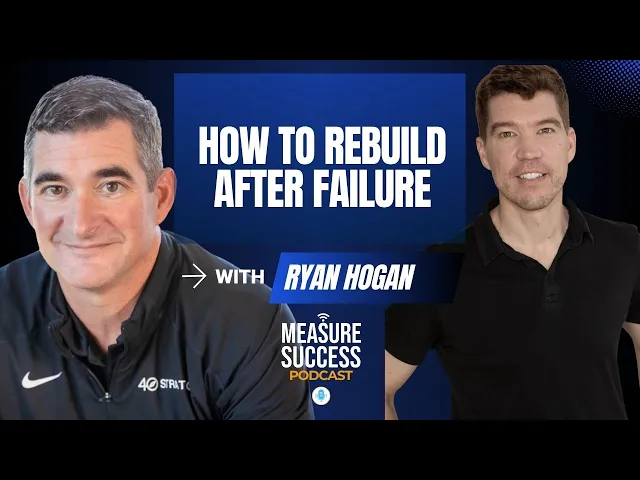
How Great Leaders Rebuild After Failure
Ryan Hogan shares lessons on bankruptcy, recruiting, leadership, and rebuilding after failure on the Measure Success Podcast.

Words by
Carl J. Cox
In this episode of the Measure Success Podcast, Carl J Cox sits down with Ryan Hogan, founder and CEO of Talent Harbor, to discuss the realities of entrepreneurship, bankruptcy, rebuilding, recruiting top talent, and finding success after failure. Ryan’s story is not a simple success story. It is a story about losing everything, rebuilding from scratch, and learning how to grow stronger businesses through better people and better systems.
Today, Ryan leads Talent Harbor, a recruiting firm focused on helping growth-minded companies hire high-impact sales leaders and operators. Before that, he built and exited Hunt A Killer, a business that grew from zero to more than $55 million in revenue.
But before that success came one of the hardest moments of his life.
The Rise and Fall of Run For Your Lives
Ryan’s entrepreneurial journey started with a company called Run For Your Lives.
The business created zombie-themed obstacle course races. Participants wore flag football belts while hundreds of zombies chased them through a 5K obstacle course.
The company exploded in popularity.
At one point:
• The business hosted 26 events
• More than 120,000 participants joined
• The company grew from zero to $5 million quickly
• The business became one of the largest events of its kind
But growth alone does not guarantee success.
Ryan explained that the company scaled too quickly without strong financial systems in place.
The business collected ticket revenue upfront while paying event costs later. The company operated from the bank account balance instead of understanding the full profit and loss picture.
When ticket sales slowed, everything changed.
The company invested more than $1 million into one event but generated only around $740,000 in ticket sales.
That gap created major financial problems.
Ryan explained that he personally guaranteed many of the contracts because he did not fully understand the risk involved at the time.
Eventually, the business collapsed into bankruptcy.
The Stress Before Bankruptcy
One of the most powerful parts of the episode focused on what happens before bankruptcy.
Ryan explained that many people only see the final moment when a company closes. They do not see the months of pressure leading up to it.
For more than a year, Ryan tried to save the company:
• Negotiating with vendors
• Managing angry customers
• Fighting to keep events alive
• Carrying financial pressure every day
The stress became overwhelming.
At the same time, Ryan was preparing to move from enlisted military service into becoming a commissioned naval aviator. Because of the stress and anxiety documented during the bankruptcy period, he lost that opportunity as well.
In one year:
• His business failed
• He lost his career path in aviation
• He faced personal bankruptcy
• He received threats from angry customers
Ryan described 2013 as the worst year of his life.
But he also described it as one of the most important years of his life.
How Ryan Rebuilt After Failure
Carl asked Ryan an important question:
How do you mentally recover after losing everything?
Ryan shared two habits that helped him move forward.
Fitness and Exercise
Ryan returned to the gym and focused on improving his physical health. Exercise became an outlet for stress and frustration.
Writing Every Morning
Ryan also developed a daily writing habit.
Every morning, he writes three pages by hand. The writing is not polished content or business material. It is simply a process to clear his thoughts and reset mentally.
Ryan explained that writing helped him remove “brain trash” before starting the day.
That daily habit became one of the most important tools in his personal growth.
Launching Hunt A Killer
A few years after the bankruptcy, Ryan started exploring entrepreneurship again.
At first, he experimented with software businesses, but those ideas failed.
Then a friend challenged him with a simple question:
Why not return to what you already understand?
That conversation led Ryan and his longtime business partner to launch Hunt A Killer.
The idea came from studying growing trends in entertainment. Podcasts and online communities focused on true crime were becoming extremely popular.
Ryan saw an opportunity.
The original version of Hunt A Killer started as a live immersive murder mystery experience. Participants solved crimes, interviewed suspects, and worked through evidence together.
The first event worked well, but it did not scale.
The team quickly realized:
• Live events limited attendance
• Logistics were expensive
• The model could not grow fast enough
So they pivoted.
Instead of bringing people to the experience, they delivered the experience directly to customers through subscription boxes.
Each month, customers received:
• Clues
• Evidence
• Story elements
• Physical objects
• Puzzle-solving experiences
The subscription model exploded in popularity.
Scaling Hunt A Killer to $55 Million
Hunt A Killer grew rapidly.
The company expanded into:
• Subscription products
• Retail distribution
• Major stores like Target and Walmart
• National media attention
Ryan explained that scaling a company from zero to more than $50 million creates constant pressure.
Every stage of growth requires different skills and different leadership.
He described how businesses hit multiple “inflection points” where:
• New systems become necessary
• New talent becomes necessary
• Old processes stop working
From the outside, the company looked exciting and glamorous.
Inside the company, there were constant operational challenges:
• Inventory management
• Supply chain problems
• Shipping delays
• Scaling teams
• Managing rapid growth
Ryan’s perspective was honest:
Rapid growth sounds exciting, but it creates nonstop complexity.
Why Great Companies Need Great People
One of the biggest lessons Ryan learned from both failure and success was this:
Businesses succeed when they have the right people.
That lesson became the foundation for Talent Harbor.
Ryan realized that recruiting top talent was broken for many small and mid-sized businesses.
Most companies:
• Copy job descriptions online
• Post jobs on hiring boards
• Wait for resumes
• Hope the right candidate appears
Ryan believes that approach does not work for elite sales talent.
Top performers usually are not searching job boards.
Instead, recruiters must actively pursue them.
The Difference Between Hunters and Farmers
Ryan explained an important sales concept during the conversation:
There are different types of salespeople.
Hunters
Hunters proactively pursue new business:
• Cold outreach
• Networking
• Building pipelines
• Creating opportunities
Farmers
Farmers focus on:
• Managing inbound opportunities
• Growing relationships
• Expanding existing accounts
Ryan explained that many companies misunderstand how to recruit strong sales hunters.
The best hunters often:
• Already perform well
• Are not searching for jobs
• Need to be recruited directly
• Want strong compensation plans
• Want growth opportunities
This creates major challenges for businesses trying to scale.
Why Recruiting Is Broken
Ryan believes the recruiting industry has a trust problem.
He compared recruiting to the used car industry years ago:
• High fees
• Low transparency
• Poor experiences
That frustration inspired Talent Harbor’s business model.
Instead of charging massive one-time recruiting fees, Talent Harbor uses a subscription-based model designed to help small and mid-sized businesses access professional recruiting support.
Ryan’s goal is simple:
Help companies hire better people without creating massive financial barriers.
The Power of Peer Groups
Another major lesson from the episode focused on peer groups.
Ryan strongly believes entrepreneurs need trusted groups of people around them.
He mentioned organizations like:
• Vistage
• EO
• YPO
• C12
According to Ryan, peer groups provide:
• Accountability
• Trusted advice
• Vendor recommendations
• Shared experience
• Emotional support
For many business owners, leadership becomes isolating.
Peer groups help solve that isolation.
Final Thoughts
This episode of the Measure Success Podcast explored entrepreneurship from every angle:
• Failure
• Bankruptcy
• Growth
• Recruiting
• Leadership
• Sales
• Scaling
• Mental resilience
Ryan Hogan shared honest insight into what entrepreneurship really looks like behind the scenes.
The biggest takeaway from the episode may be this:
Failure does not end your story unless you stop building.
To learn more about Ryan Hogan and Talent Harbor, visit Talent Harbor or connect with Ryan on LinkedIn.
Listen to the full Measure Success Podcast episode today and continue building a strategy that helps you measure success the right way.


