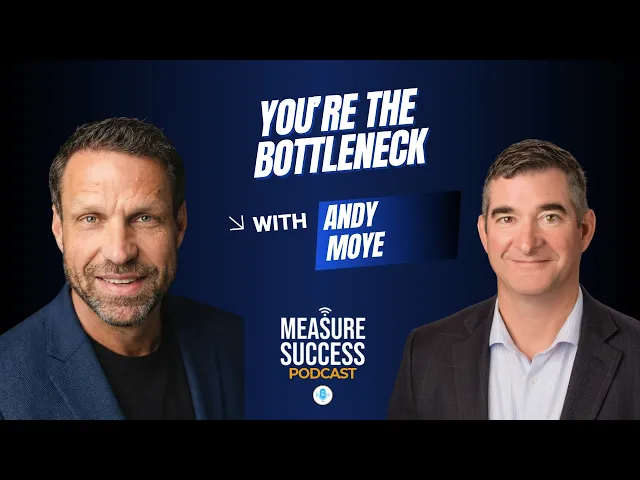
You're the Bottleneck: Leadership Lessons From Combat
Navy pilot turned healthcare CEO Andy Moye shares leadership lessons on purpose, adaptability, and empowered teams on the Measure Success Podcast. Listen now.

Words by
Carl J. Cox
Most leaders think the problem is somewhere else in the organization. Often, it's at the top. When a founder keeps every big decision flowing through one person, growth hits a ceiling. And the ceiling is the founder.
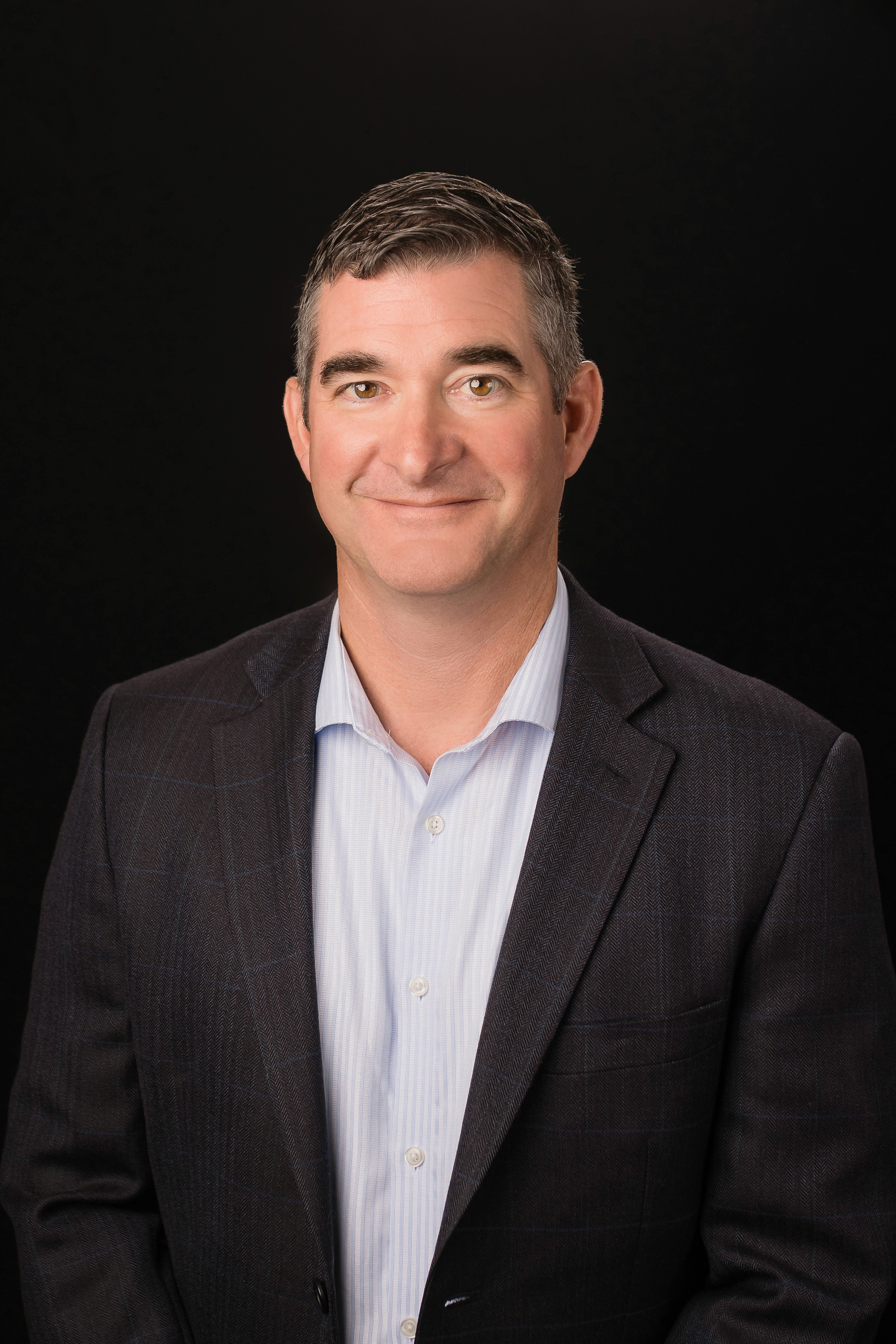
In this episode of the Measure Success Podcast, I sat down with Dr. Andy Moye, a healthcare technology executive, entrepreneur, and author, to discuss battle-tested leadership, adaptive thinking, and how AI can help more cancer patients reach the therapies that could save their lives.
Andy is a former US Navy aviation officer who served two combat deployments in Operation Enduring Freedom and Iraqi Freedom. He is the founder of Glidepath Health, a healthcare technology company using AI to improve access to cell and gene therapies. He previously served as CEO and board member of Paige, a spin-out of Memorial Sloan Kettering Cancer Center, and as a senior executive at Tempus AI. He is also the author of From Bunker Hill to the Boardroom: Battle-Tested Leadership for Today's Executives.
The Scariest Moment in the Cockpit
Everyone wants to be a Top Gun pilot.
Andy flew something different.
He flew the P-3, a large, four-propeller, long-range aircraft originally designed for hunting submarines during the Cold War. His crew nickname for it was "prop gun."
His scariest moment came on the first combat flight over Iraq in 2003.
• Ten people on the aircraft
• Threats are supposed to be called out with specific, trained language
• Instead, the crew reacted with raw panic
• The plane is not very maneuverable
You can train. You can plan. You can run the simulators.
Then reality punches you in the mouth.
That is the first lesson in leadership: you will face things you are never fully ready for.
You do them anyway, and you figure it out.
Why Most Cancer Patients Never Reach Advanced Therapies
Andy's company, Glidepath Health, focuses on cell and gene therapy.
These are advanced treatments that take enormous effort to coordinate and schedule.
Today they are mostly given in big hospitals in big cities.
But most care in this country is delivered in community and rural settings.
Andy said they are missing 80 to 90 percent of the patients who could benefit from these curative therapies because the infrastructure is not in place.
His approach is simple:
"You have to solve one thing at a time."
The Hidden Waste in Patient Scheduling
Picture what it takes to get one patient treated.
• Labs and scans
• A process where cells are pulled from the patient's body
• A manufacturing slot that has to be available at exactly the right time
• Lymphodepletion before the new cells go in
• Dozens of doctors, pharmacists, nurse coordinators, and techs
Andy described how this is handled today: phone calls, texts, emails, and spreadsheets.
No one has full visibility into what is happening.
That is before you even get to financial clearance and insurance approval.
Andy shared a statistic from studies: about 44 percent of patients identified as good candidates for these drugs never actually receive them.
The process stalls. The scheduling falls apart. The patient gets too sick. The wait is too long.
Glidepath uses AI to pull information into one place and predict when drugs will come back and when patients should be scheduled.
The goal is a 50 to 60 percent reduction in waste and bottlenecks.
And as I said in the conversation, "patient" is a person's life.
From Family Genealogy to a Leadership Book
Andy never set out to write a book.
It started with his son during COVID, who wanted to understand the family name.
An ancestry test turned into a genealogy rabbit hole.
• His father served 25 years in the Army, including Vietnam
• A relative fought in the Civil War
• Further back, a father and son fought in the North Carolina militia during the Revolutionary War
Andy wrote a LinkedIn post about it. It took off, and a publisher reached out.
But he did not want to write a family history or a military history.
He wanted to show leadership principles that run through every era of American combat and still apply to leaders today.
That became three pillars.
Pillar One: Purpose Over Vision
In the eighties and nineties, leadership was all about vision.
Andy points out that if you asked rank-and-file employees what the vision statement was, many could not tell you.
His challenge to leaders is different.
Tie each person's individual purpose to the company's purpose.
At Paige, the purpose was noble: advance cancer diagnostics and save more lives.
But Andy also had salespeople who wanted to make money and buy a boat. That works too. Patients get better, and the salesperson gets the lake.
Engineers wanted to work on cutting-edge AI. They could do that while building products that help patients.
The danger is a leadership team whose individual purposes do not match the company's.
When that happens, Andy says, you have to identify it and be willing to show someone the door.
Pillar Two: Adaptive Intelligence
Andy believes this pillar is underrated in business.
In the military, officers are trained for adaptive intelligence because combat is dynamic.
Your plan gets punched in the mouth.
He pointed to classic business examples:
• Kodak invented the digital camera
• Xerox invented the personal computer
• Both had solutions that made so much money they would not disrupt themselves
Today, AI is doing the same thing to companies that cannot adapt.
I added a military example: on D-Day, troops were scattered everywhere, but they understood the commander's intent and organized around the mission.
Pillar Three: Empowered Teams
Founders want a tight rein on decisions.
After a while, every decision runs through one leader.
And then, as Andy put it, the board will find it for you:
"You're the bottleneck. You're the problem."
If your team does not understand the mission and does not have the authority to act, you hit a ceiling.
"And the ceiling is you."
Andy credited General Stanley McChrystal, author of Team of Teams, who wrote the foreword to his book.
Commander's Intent for Business Leaders
This idea came up again and again.
Andy still has to bring his own product team back to the big picture.
Sometimes the platoon goes off chasing rabbits.
As a leader, you have the field of view.
The Roman commander took the high ground so he could see the battlefield and move forces.
Most leaders do not communicate the why often enough, or at all.
When people understand the why:
• Employees are engaged
• Product outcomes improve
• Sales teams perform better
• Operations run better
I shared a related truth from my own work.
When I am brought in by private equity to evaluate a company, a hundred percent of the time there is a change in leadership.
Usually one key person is bottlenecking success.
Living in Two Worlds
I asked Andy for one habit that keeps him focused.
He gave two.
First, take care of yourself.
Workouts. Sleep. Eating well.
"They sort of deserve your best every day."
Second, live in two worlds.
Andy learned from a mentor that the hardest part of growing as a leader is holding both time horizons at once:
• The long term: vision, purpose, where we will be in one, three, and five years
• The immediate: today's priorities, people, process, and product
His rhythm is big-picture thinking in the morning, then managing today and this week for the rest of the day.
I shared my own habit: I recorded my vision for the next decade and listen to it every day on Speechify.
Final Thoughts
Leadership is not about holding every decision.
It is about making sure everyone knows where you are going and why.
Andy's three pillars:
• Purpose over vision
• Adaptive intelligence
• Empowered teams
And underneath it all is legacy.
Andy measures success personally by what his kids will remember about him, and professionally by how many patients he can help.
To learn more about Andy Moye, visit andymoye.com. You can also find his book, From Bunker Hill to the Boardroom, at andymoye.com/book, and connect with him on LinkedIn for more on leadership, AI, and healthcare.
Listen to the full episode and ask yourself:
Where are you the ceiling for your team?


