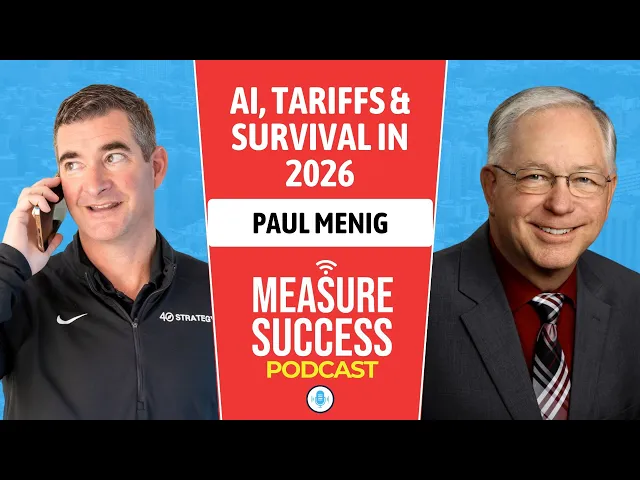
AI, Tariffs & Survival in 2026
In this episode of the Measure Success Podcast, host Carl J Cox sits down with Paul Menig, CEO of Business Accelerants, to unpack some of the most pressing challenges facing manufacturing and small to mid-sized businesses today. With decades of experience in engineering, manufacturing, and strategy, Paul brings practical insights into how leaders can navigate tariffs, pricing pressures, AI, and the evolving competitive landscape. This article expands on the episode’s conversation, offering actionable takeaways for leaders who want to future-proof their business heading into 2026 and beyond.

Words by
Carl J. Cox
Why Businesses Are Tariff-ified: Strategies for Surviving Tariffs, AI, and Market Shifts
Why Companies Are “Tariff-ified”
Paul coined the term “tariff-ified” to describe how many manufacturing companies are reacting to new and unpredictable tariffs. Constantly shifting regulations and trade rules make it hard for leaders to plan and price products. Many companies that once relied on steady supply chains now find themselves forced to deal with increased landed costs, unpredictable shipping activity, and changing rules around imports.
Some manufacturers have tried to bypass tariffs through creative strategies, like using foreign trade zones or rerouting through different countries. But these are often temporary fixes, not long-term solutions. And for smaller businesses that don’t have deep compliance teams, the uncertainty can be paralyzing.
Key Takeaway:
Businesses can’t ignore tariffs or treat them as a short-term issue. Leaders need proactive pricing, sourcing, and communication strategies to adapt quickly when trade rules shift.
The Pricing Puzzle: Cost-Plus vs. Value-Based Pricing
Traditionally, many manufacturers have priced products with a simple cost-plus model: take costs, add a margin, and set the price. But tariffs, supply chain volatility, and rising labor expenses are exposing the weaknesses of this model. When costs fluctuate dramatically, rigid formulas can squeeze margins and undermine profitability.
Paul explained that while some companies are passing tariffs straight through to customers, others are absorbing the hit to avoid losing sales. But both approaches come with risk. The better path may be shifting toward value-based pricing—charging based on the perceived value and differentiation of a product, not just cost.
For example, a supplier known for consistent delivery may win bids even with higher prices. Similarly, niche products or spare parts that customers desperately need can justify higher margins.
Key Takeaway:
Leaders must evaluate where they can pass costs through, where they can charge based on value, and where they need to restructure product lines to maximize gross margin dollars—not just percentages.
Supply Chains and Sourcing in Flux
One of the most difficult challenges businesses face today is finding reliable alternative sources of supply. Moving manufacturing from China to Vietnam or Mexico may look appealing, but real options are limited. Even when parts are sourced elsewhere, companies can’t always verify origin, and regulatory scrutiny is tightening.
Automation in the U.S. is one solution, but it requires significant upfront investment, technical skills, and new labor strategies. Leaders need to weigh whether to double down on automation or continue to diversify internationally.
Key Takeaway:
Resilient supply chains demand creativity, risk analysis, and investment in automation. Leaders must plan for contingencies, not just immediate cost savings.
AI in Manufacturing and Beyond
AI has been around for decades, but its accessibility and impact have exploded in recent years. Paul shared examples from his career: machine vision inspecting soap bars and circuit boards in the 1980s. What once took years of research can now be done in weeks with modern AI tools.
Today, AI is transforming both back-office and front-office functions. In manufacturing, AI enables real-time monitoring, defect detection, and predictive maintenance. In marketing, AI helps small businesses create content, improve SEO, and compete with larger firms.
Carl highlighted how AI can accelerate vision and strategy work for leadership teams—cutting hours of brainstorming into focused, actionable sessions. Instead of spending months wordsmithing mission statements, leaders can use AI to create clear drafts in minutes and focus on alignment and execution.
Key Takeaway:
AI isn’t just for big corporations. Small and mid-sized businesses can leverage AI tools to improve efficiency, accelerate strategy, and enhance customer-facing communication.
The Competitive Threat: Private Equity and Consolidation
Carl raised an important warning: private equity firms are quietly reshaping industries by consolidating local businesses and dominating digital visibility. Companies that once relied on word of mouth or traditional ads are finding themselves invisible on AI-driven search tools like ChatGPT and Perplexity.
This shift means small businesses must change how they attract customers. Traditional Google ads and keyword SEO aren’t enough. Instead, they need strong content strategies, authentic storytelling, and continuous publishing across platforms.
Paul emphasized that small businesses should focus on creating consistent, high-quality content—videos, blogs, testimonials—that AI search models recognize and elevate. Restaurants, for example, can boost visibility by showcasing new menus, chef videos, and customer reviews rather than relying only on static websites.
Key Takeaway:
Content is the new currency of visibility. To stay competitive, small businesses must invest in creating and publishing content regularly.
The Future of Autonomous Vehicles
The conversation also touched on the future of automation and AI in transportation. Autonomous trucks are already hauling freight in limited regions like the Southwest U.S., though most still require human oversight. While full automation may take decades, hybrid models are already improving efficiency and reducing delivery times.
For leaders, the broader lesson is clear: automation is no longer a future concept. It’s happening now, and those who adapt early will benefit.
Key Takeaway:
Expect gradual adoption of autonomous technologies. Leaders should monitor progress and explore where automation can improve operations today.
Practical Strategies for 2026 and Beyond
As the discussion wrapped up, Paul outlined practical steps small and mid-sized businesses should take:
Know your customer’s customer. Don’t just understand your buyers—study their customers and distribution chains to see where margins and opportunities lie.
Invest in content. Regular, authentic content is essential to remain visible in an AI-driven search world.
Leverage AI for efficiency. Use AI to accelerate documentation, visioning, marketing, and back-office processes.
Evaluate product lines. Cut or reprice low-volume, low-margin products that drag down profitability.
Build supply chain resilience. Diversify sourcing, explore automation, and plan for disruption.
Final Thought:
As Paul summed it up, businesses can survive—and thrive—if they adapt. The companies that refuse to change risk being left behind in a fast-moving world.
Subscribe Below
Want to learn more about building strategies that last? Listen to the full conversation with Paul Menig on the Measure Success Podcast. Subscribe on your favorite platform, and start applying these insights to prepare your business for 2026 and beyond.
👉 Listen here


