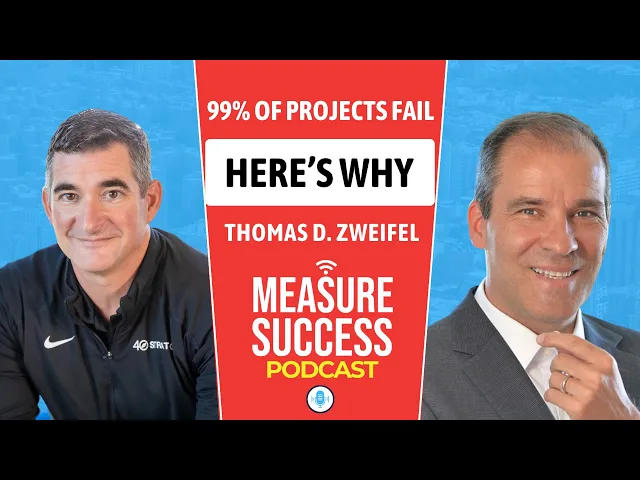
99% of Projects Fail—Here’s Why
On this episode of the Measure Success Podcast, host Carl J Cox speaks with Dr. Thomas Zweifel, Swiss-American leadership expert, award-winning author, and strategic advisor. Dr. Zweifel has coached Fortune 500 executives, government leaders, and entrepreneurs worldwide, and his latest book, Gorilla in the Cockpit, explores why so many projects fail—and what leaders can do about it.


Words by
Carl J. Cox
Why 99% of Projects Fail: Lessons from Gorilla in the Cockpit
This article expands on their conversation, highlighting the hidden human factors behind project breakdowns, the power of mindset and accountability, and the practical steps leaders can take to transform breakdowns into breakthroughs.
Why Do 99% of Projects Fail?
According to project management research, the overwhelming majority of projects fail—whether they are mega-projects like airports and military programs or everyday projects like home renovations. Failure is defined as going over budget, over time, or failing to achieve the intended outcomes.
Dr. Zweifel emphasizes that the root cause is rarely technical. Instead, it is the human factor. Projects derail not because of poor design or weak technology, but because of politics, bias, culture, and unspoken conversations that undermine execution.
Key Takeaway:
Leaders must stop focusing only on the “hard” side of projects and start addressing the hidden human dynamics that make or break success.
The Gorilla in the Cockpit Metaphor
The book’s title, Gorilla in the Cockpit, captures the feeling of being overwhelmed in a high-stakes situation. Imagine being in a cockpit, facing fast-moving challenges, uncertain data, and high pressure to perform—while a metaphorical gorilla looms large, distracting and destabilizing everything.
For project leaders, that gorilla is the hidden human factor. Misaligned expectations, political agendas, cultural blind spots, and communication breakdowns all create invisible risks. Left unaddressed, these risks cause projects to miss deadlines, exceed budgets, or fail altogether.
Key Takeaway:
To lead projects effectively, leaders must identify and address the “gorilla” in the room—the human issues no one wants to name.
The White Box and the Black Box
Dr. Zweifel distinguishes between two domains of project management:
The White Box: The technical and visible aspects—contracts, business cases, procurement, execution, and deliverables.
The Black Box: The hidden human dynamics—politics, bias, cultural factors, unspoken assumptions, and background conversations.
While most leaders obsess over the White Box, it’s the Black Box that often determines success or failure.
For example, background conversations—things people say privately but never raise in meetings—shape execution. Resignation, blame, or unspoken fears spread silently through organizations, undermining progress.
Key Takeaway:
Success requires surfacing and addressing the Black Box issues. Leaders must listen between the lines and bring hidden conversations into the open.
Mindset: The Invisible Driver of Results
Dr. Zweifel compares leadership to marathon running. Physical ability matters, but mindset determines performance. Elite athletes, soldiers, and entrepreneurs all rely on mental discipline to push beyond perceived limits.
In projects, the same principle applies. Teams that believe “we can do this” approach challenges with resilience. Teams resigned to failure, consciously or unconsciously, deliver poor results.
Key Takeaway:
Mindset is not just an individual issue—it is cultural. Leaders must cultivate a culture that believes in possibility, accountability, and follow-through.
From Breakdown to Breakthrough
Breakdowns in projects are inevitable. Budgets overrun. Deadlines slip. Stakeholders disagree. The danger is when leaders ignore breakdowns or hide them in the Black Box. This avoidance accelerates failure.
Dr. Zweifel argues that declaring breakdowns openly is the key to turning them into breakthroughs. By naming problems, leaders can mobilize teams, adjust strategies, and spark innovation. Many of the world’s greatest innovations—from Post-it Notes to scientific discoveries—originated from breakdowns.
Key Takeaway:
Don’t hide breakdowns. Declare them. Use them as catalysts for learning, innovation, and transformation.
Case Study: The Guggenheim in Bilbao
One powerful example from the book is the Guggenheim Museum in Bilbao, Spain. At the time, Bilbao was a struggling industrial city. Yet the museum project succeeded spectacularly, transforming the city’s economy and brand.
What made it different? At every stage—governance, business case, procurement, execution, and delivery—the leaders addressed both the White Box and the Black Box. They minimized political interference, encouraged straight talk, and practiced promise-based management. Instead of hiding issues, they brought them to the surface.
The result: an on-time, on-budget project that not only achieved its goals but revitalized an entire region.
Key Takeaway:
Projects succeed when leaders combine technical excellence with integrity, accountability, and open communication.
Practical Steps for Leaders
What can leaders do to avoid failure and join the 1% of successful projects? Dr. Zweifel offers several actionable practices:
Listen between the lines. Pay attention to what team members aren’t saying. Look for signs of resignation, fear, or disengagement.
Surface background conversations. Bring hidden issues into the open. Create safe spaces for truth-telling.
Shift from time management to commitment management. Time is finite, but commitments can be kept or renegotiated. Lead with promises, not tasks.
Declare breakdowns early. Don’t wait until failure is unavoidable. Use breakdowns as opportunities for breakthroughs.
Build cultures of accountability. Encourage people to take ownership rather than hide behind authority or blame others.
Final Thought:
Projects fail because leaders fail to address the human side. Success requires courage: the courage to listen, to name what’s unspoken, and to lead with integrity.
Subscribe Below
Want to uncover the hidden gorillas in your projects? Listen to the full conversation with Dr. Thomas Zweifel on the Measure Success Podcast. You’ll learn practical strategies to surface the human factors that derail projects and how to transform breakdowns into breakthroughs.
👉 Listen here