The Hunt for October (Habits)

t’s time to get up. The fourth quarter is here!
Despite every natural instinct telling me to stay comfortable in bed, two very annoying alarms finally did their job, and I rolled out of bed just after 5:00 a.m.
My preference would have been to stay there for another hour.
But that’s not how I’m able to consistently do great work. If I’m waiting for things to happen and simply hoping they come together, I’m already behind.
Progress takes effort.
With the morning temperature in the low 40s, I slowly grabbed my jacket, gloves, and stocking cap and started walking the one-mile loop along the country roads near my house.
The moonlight provided nearly all the light I needed on that pre-dawn morning.
It was beautiful.
I have to admit though, the combination of colder mornings, darker days, and a fair amount of travel had stopped some of my positive habits in their tracks.
And this is the time of year when that happens to a lot of us.
Good habits that started strong in January have often disappeared by October.
According to HabitBox, only 9% to 13% of people successfully keep their New Year’s resolutions. And with the holidays right around the corner, it becomes easy to say:
Why start now? I’ll just start again in January.
Of course, we know how that story usually goes. Nearly half of New Year’s resolutions are abandoned by January 31.
So, no.
Now is not the time to crawl back into bed.
My dad used to tell me that my grandmother would say to my grandfather when he slept in:
“Get up, get up! You can sleep when you’re dead!”
Maybe Grandma was onto something.
It’s time to get back on track.
For me, that means restarting the habits I know make a difference: walking, stretching, daily devotionals, and push-ups.
When I’m consistent with those habits, I feel better. I think better. I behave better.
Although I have to admit, this engine takes a little longer to get started than it used to.
A few days ago, I was driving between offices when I noticed a truck ahead of me dragging a chain along the road. The chain was literally throwing sparks everywhere.
The driver had no idea the havoc he was creating behind him.
And I thought:
That’s what happens when we get out of our good habits.
We start dragging things behind us.
We create unnecessary friction.
We’re less prepared for the day. We become less patient. Things take longer than they should. Small problems become bigger problems.
Sometimes we don’t even realize how many sparks we’re creating.
Over the next month, with our 40 Strategy Growth Workshop™ approaching, I’ll be on the road more than I’ll be at home.
Which means my habits will matter even more.
It’s time to get up.
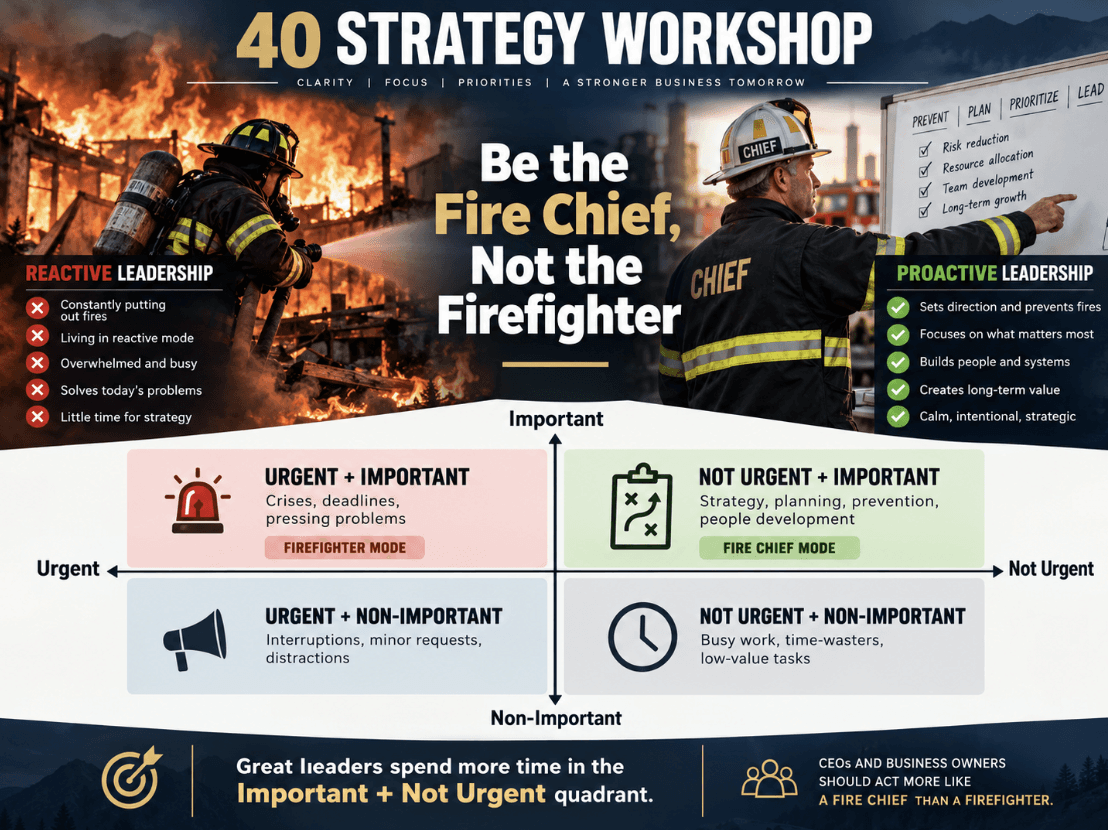
Next, it’s time to focus.
Our client list continues to grow. New employees are joining our team. There are more opportunities in front of us than there were a year ago.
Those are all good things.
But I’ve also realized that I’ve allowed too many non-essential things to creep into my calendar.
I’ve been very busy.
But I haven’t always been busy doing the right things.
There is a huge difference.
One of the biggest challenges for a CEO or business owner is moving away from work that is urgent but not important and protecting time for work that is important but not urgent.
Strategy.
Planning.
Developing people.
Building relationships.
Thinking about what comes next.
It doesn’t mean we ignore urgent problems. But as leaders, we should spend more of our time acting like the fire chief instead of the firefighter.
The objective is to prevent fires, not spend every day getting burned out putting them out.
Finally, put your time where you create the most value.
Most CEOs and business owners want more revenue and more income.
That makes sense.
But many of those same owners will spend their day taking out the trash, doing bookkeeping, fixing technology problems, scheduling appointments, or completing work someone else could easily do.
It’s not because you’re “above” that work.
You’re not.
The problem is that every hour you spend doing lower-value work is an hour you aren’t spending doing the work that only you can do.
Here’s a simple way to think about it.
If you’re a full-time business owner and you want your company to generate $1 million in annual revenue, your time needs to increasingly be focused on activities capable of creating roughly $500 of value per hour.
$500/hour × 2,000 hours = $1,000,000
That doesn’t mean every hour magically produces $500 of revenue.
It means your time should increasingly be directed toward decisions, relationships, strategy, sales, leadership, and activities capable of creating that level of economic value.
So if you’re spending three hours doing bookkeeping, ask yourself:
What is the economic value of those three hours?
And more importantly:
What could I have been doing instead?
As we enter the fourth quarter and you begin thinking about your 2027 plan, I want you to ask yourself two questions:
Am I spending enough time on work that is important but not urgent?
And:
Am I spending my time doing work that supports the revenue and value I want my business to create?
October doesn’t have to be the month when you give up on your habits and wait for January.
It can be the month when you restart them.
Get up.
Get focused.
And put your time where it creates the most value.
The fourth quarter is here.
And there is still plenty of time left on the clock.
If becoming a more valuable business owner, one who consistently hits their target, is part of your 2027 plan, we fortunately still have a few spots remaining for the upcoming
40 Strategy Growth Workshop.
Maybe the best time to start your 2027 plan isn’t January.
Maybe it’s October.

|


