Strategy for Veterans

Veterans Day History
It's fascinating how we celebrate our national holidays and don’t necessarily remember the history as to why they exist. Today, on this Veterans Day, my goal was to learn more about this special holiday, and thank those who have served in the military.
Did you know that…
There is no apostrophe with Veterans Day.
In 1954, Armistice Day, which was the day to celebrate the end of World War I, was changed to Veterans Day, to honor Americans of all wars.
According to the Department of Veterans Affairs, November 11th is set aside to thank and honor ALL those served in the military in wartime OR peacetime.
The day is intended to thank the LIVING Veterans and their service. We acknowledge that their contributions to our national security are appreciated and to underscore the fact that those who service - not only those who died - have sacrificed and done their duty.
Changing Military Demographics
This article written by Katherin Schaeffer, from Pew Research, highlights the changing face of the US military.
Only 6% (18 million) of the current US population served in the military, or 1 of every 16 people. This is compared 18%, or 1 of every 6 people in 1980. That’s a big difference.
Veterans of the current US population:
43% served in the Gulf War era (7.8M)
30% served in the Vietnam War era (5.6M)
4% served in the Korean War era (.8M)
<1% served in WWII (120K)
I would like to personally thank my closest relatives who are Veterans, my father-in-law Skip Heiney (Navy), brother-in-law Ben Heiney (Navy), brother, Jim Talty (Army), and nephew Josh Talty (Airborne).
The 1%
Only one percent of the current US population, or 1.3M, are active duty. This one percent is responsible for national security. And it goes without saying, there are a lot of active national security risks. They help the remaining 339M Americans sleep better at night.
As a result, we are less likely to know someone who is directly serving today. So today, please reach out and make an opportunity to thank them as well. Their dedication and sleepless nights; enable the rest of us to perform the great work that we do today in business, government, education, and not-for-profit organizations.
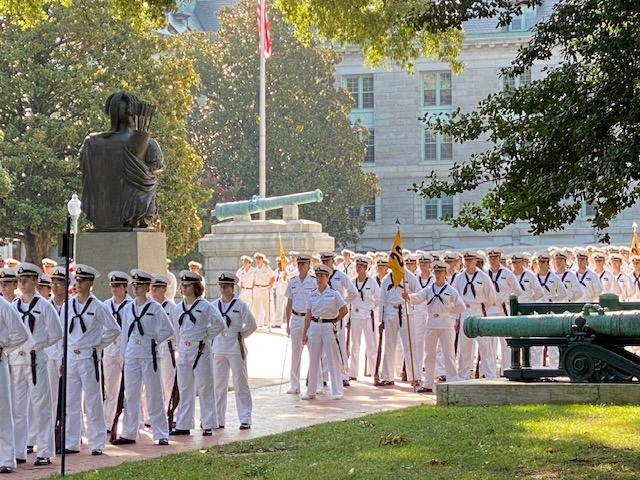
Picture below: US Naval Academy
Military’s Impact on Business Strategy
A significant portion of business strategy roots started with military planning. One of the earliest strategic books is the Art of War by Sun Tzu, roughly 5th century BC. If you have not read this book, it is truly a classic, see the Amazon link. A modern well written book is Leadership, Strategy, and Tactics, by former Navy SEAL and current business consultant, Jocko Willink.
Basic strategic terms, such as, tactics, operational, fortification, maneuver, withdrawal, surprise, organization, personnel, logistics, are derived from military use.
Anytime there is a risk of loss of life, it is essential that you pay attention to strategic planning and training. Literally, lives are at stake. This Forbes article outlines the Seven Steps for Effective Planing used by most elite special operations teams and high-performance organizations.
Step 1: Identify the Specific Objective
Step 2: Understand Blockages
Step 3: List Resources
Step 4: Apply Lessons Learned
Step 5: Actions (What, When, Who)
Step 6: Red Teaming (Identify gaps)
Step 7: Develop Contingencies
The 40 Strategy Name
Most small to medium-sized businesses, spend only 2% of their time on strategic planning. This helps explain why 90% of organizations fail to execute their strategies successfully. This is how we came up with the name 40 Strategy. Two percent of a full year is roughly 40 business hours, i.e., 40 Strategy. As most organizations do not focus their time on learning strategy, it's difficult to be great at it. Thus, we focus our client time on best practices for strategic facilitation, design, and execution methodologies.
As a result, our clients grade in the top 10% or higher, by applying those 40 hours using our CAPTAIN strategy methodology.
In most business, it is not a matter of life and death. However, great strategic planning and execution can help you get to your final destination much faster. And, most likely, far more profitable.