Half-Way Done

Are you measuring your success for the first half of the year? How close are you to reaching your destination (goals) that you set for 2023?
Did you know that the stock market (S&P 500) is up 15.9% in 2023? Did you know that the NASDAQ has gained 31.7%, its best first half in 40 years?
At the end of any quarter, or half-way point, we should be measuring our success. For most companies and organizations, this is when we measure progress on total revenue (sales), (fundraising for NFPs), and profits.
As an individual, how well are you meeting your weight goals? How close are you to running your first 5K, 10K, or marathon? How about walking 500 miles, like my oldest daughter Ashley and niece Maggie will be starting soon in Spain?
Lagging Indicators
So now that we measured our first half progress, what should we be measuring in the 2nd half of the year?
Most organizations continue to measure the lagging measure. They will continue to measure their revenue on a monthly basis. If you are an individual, you may continue to hop on the scale hoping to check your weight.
However, we do not increase our revenue by looking at our revenue numbers. Just like we don’t lose weight by hopping on the scale.
Leading Indicators
Harvard Business Review research validates that if we focus on our leading indicators, rather than our lagging indicators, we are 3x more likely to reach our goals.
From a sales perspective, we have to review, what actions do have in our control, that can have an impact on the outcome. If you have an outbound sales force, leading indicators may include the following:
Outbound calls to connect with sales leads
Product demos with prospects
New quotes generated
Close percentage
If you are walking 500 miles, a leading indicator would be the performing training walks.
If you are trying to lose weight, you should measure your calorie intake and exercise.
Let's go back to the sales example, let's say one sales person is trying to close $1 million worth of business in the 2nd half of the year. What would it take to get there? (See example at the end of the blog)
Book Quotes
Senior contributor and economist Bill Conerly wrote in Forbes magazine, Businesses should not optimize everything. Here’s a piece of it…
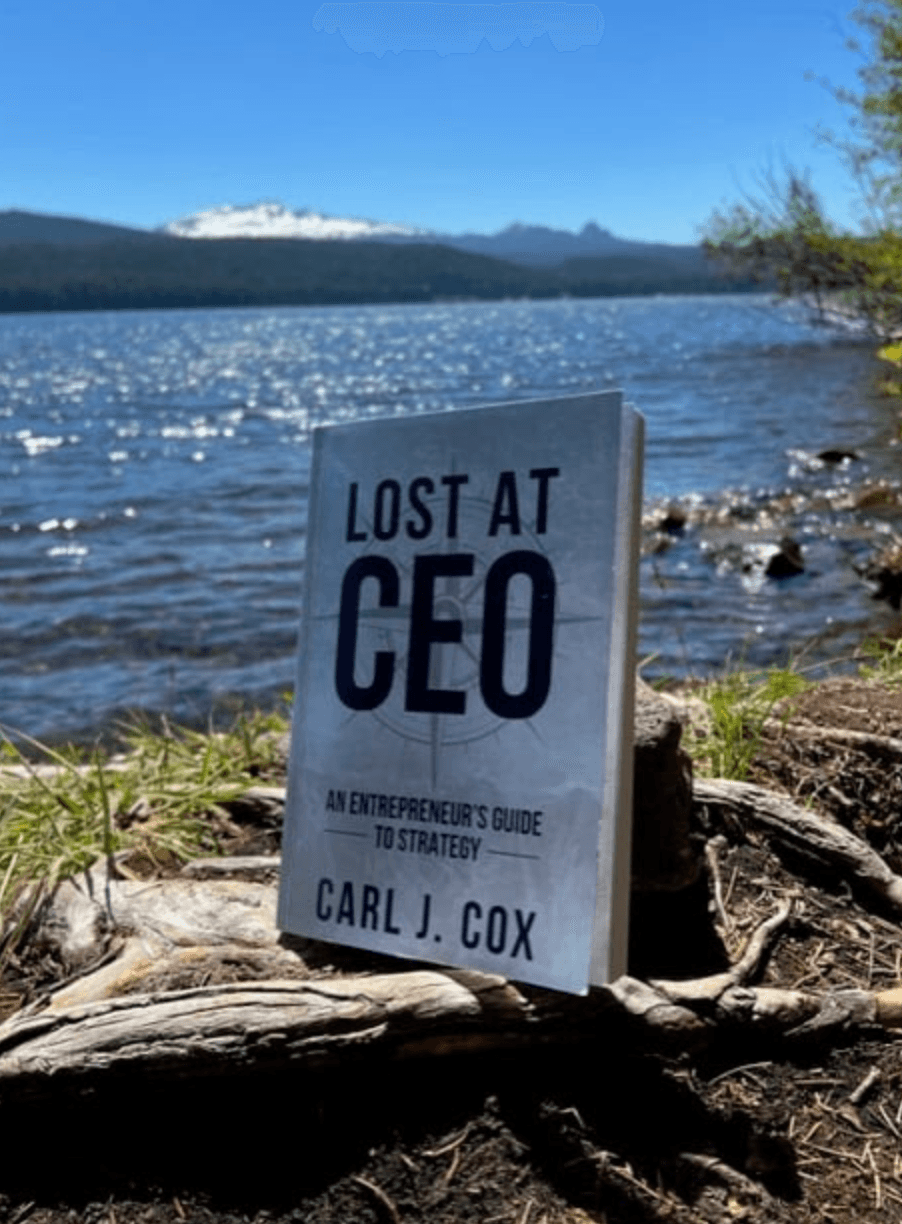
“The business principle behind that is illustrated in a forthcoming book by Carl Cox, Lost at CEO. This business strategy book in the form of a novel (think The Goal for C-suite strategy) has a telling segment when the CEO impresses on the management team the need to grow sales—but some managers translate that goal into working more hours. One has been putting in long workweeks and doubts he, they can take more time away from the family without facing a divorce. The solution—easy to see from the outside—comes from prioritizing the activities that will make the largest impact in the available time. Other tasks are left at good enough.”
Favorite Book Picture of the Week (pictured above)
Lost at CEO picture at Odell Lake. Thanks to my brother Jim Talty!
Hypothetical sales leading and lagging example:
From experience, you have learned the following:
Deal Size:
Your typical deal size is $50,000, therefore you would have to close 20 deals to sales $1 million.
$1,000,000 Sales Goal
/ $50,000 Average Deal Size
= 20 Deals
Quote History:
For every quote that you generate, you typically win 50% of them; therefore you would have to create 40 quotes.
You win 50% of quotes.
20 Deals / 50% quote win percentage = 40 Quotes
Product Demos:
Your product demo is amazing, and 50% of your product demos results in a quote.
40 quotes / 50% = 80 Product Demos
Outbound Sales Calls:
10% of your outbound sales calls, result in a product demo. 80 product demos / 10% = 800 sales calls.
Initially, this looks overwhelming, but let's break this down into our weekly leading indicators to win $1 million in business:
800 sales calls / 26 weeks = ~31 calls per week or 6 calls per day.
80 product demos = 3 demos per week.
40 quotes = 1.5 quotes per week
20 deals = ~ 1 deal per week
This is something that can be done.
Track the leading indicators weekly to meet and exceed your $1M goal.