Going Against the Grain (Including My Own Plan)
I had a plan… until the market told me otherwise.
Building 40 Accounting was not part of the original strategy.
It started with a simple request. A client needed a bookkeeper. I began searching and someone suggested hiring their niece, a student at the University of Hawaii.
She started doing bookkeeping for that one client. Then another client asked for help. Then another. It grew organically because we were solving a real problem.
Along the way we discovered something troubling.
Bookkeeping, tax reporting, financial reporting, and financial analysis for small businesses are often slow, inaccurate, and poorly delivered.
Timely financial statements? Forget about it.
There is a major shortage of quality accountants. According to Kiplinger, Nearly 70% of CPAs are approaching retirement age. For years the path to becoming a CPA became more difficult. Firms moved work offshore. Private equity began consolidating firms. Technology changed expectations.
The result?
Small-business accounting has become a mess.
More than 80% of the tax returns we receive from new clients contain errors. Not complex tax issues, basic math. Balance sheets that don’t tie. Equity that doesn’t roll forward.
This is why 40 Accounting continues to grow. We are simply solving a market problem. Small businesses are not receiving the service they deserve, so we are doing our best to serve that market across the country.
The Original Strategy
Our original strategy was straightforward:
Build a remote workforce
Avoid physical offices
Recruit experienced accountants in the US who preferred remote work
Use offshore firms to support growth
Minimize supervision
It made sense on paper.
But there was one problem.
Training great accountants is not easy
Accounting requires repetition and supervision. You learn by doing the work, making mistakes, and receiving feedback.
When I started as an associate at Coopers & Lybrand (now PwC), I learned more in the first six months than I learned during four years at the University of Washington.
And that was not because the University of Washington had a weak program. In fact, it was one of the top accounting programs in the country.
The difference was repetition and feedback.
In school I attended about 15 hours of classes each week and studied another 8 to 10 hours depending on exams.
At work I was logging 40 to 65 hours per week, often with four levels of review on a single piece of work.
Back then it was all on paper. Review notes came in red, blue, green, and sometimes black ink from the partner. My work looked like rainbow writing.
It was painful.
But you learned.
You learned how to see errors, trace problems, and understand what went wrong.
Later I spent five years at a publicly traded company supporting our SEC reporting and implementing Sarbanes-Oxley. When the rules say you can go to jail for signing incorrect numbers, you learn very quickly to make sure debits and credits are right.
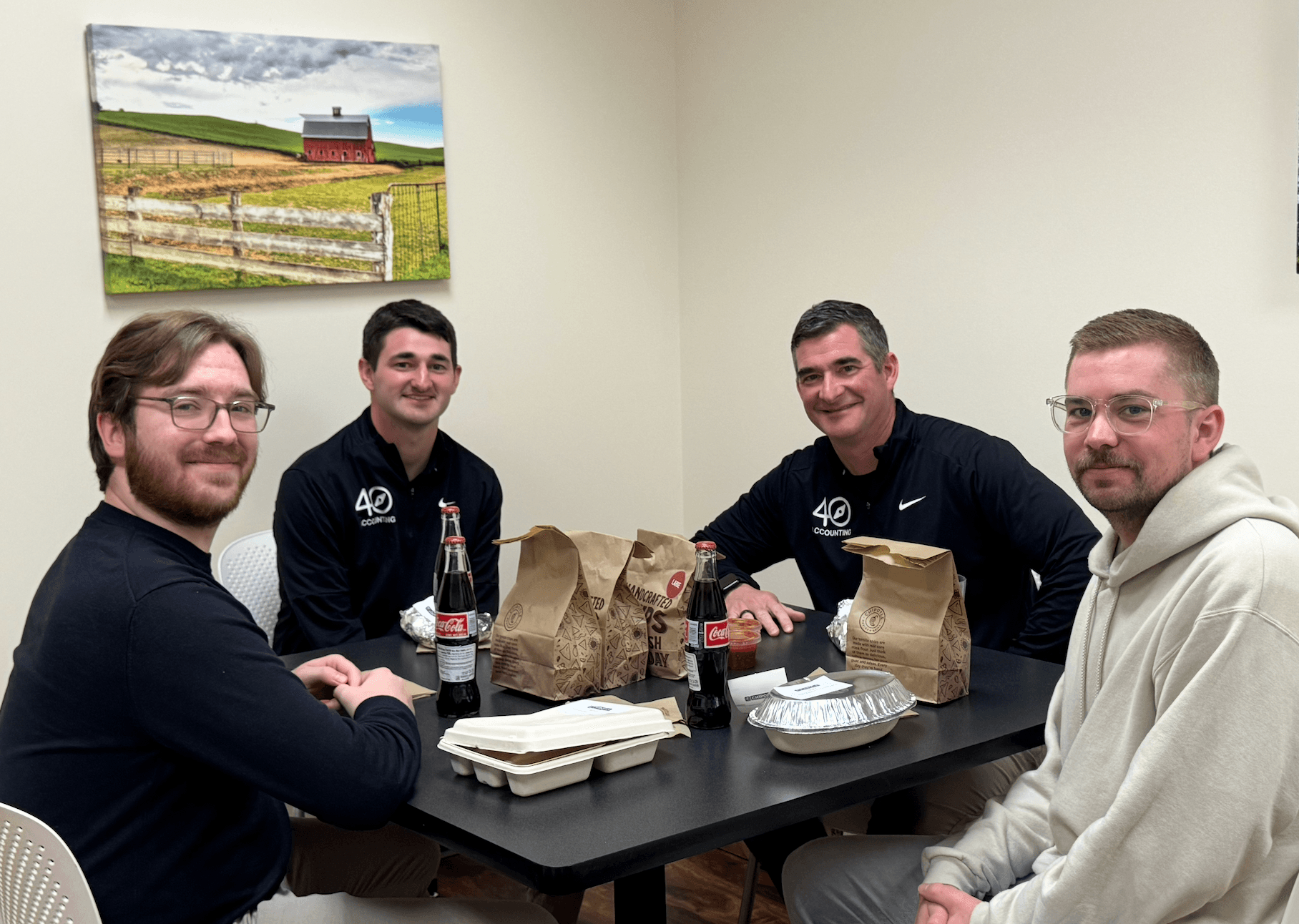
(Ben Heiney, Zach Cox, Carl J. Cox, Nick Cuddigan)
The Insight
Over time something became clear.
If we want great accountants, we have to train them.
So we changed course.
We started hiring local graduates to work inside our office where we can mentor and train them properly.
Part of this insight came from hiring my nephew, Ben, from the University of Oregon. Like many recent graduates, he struggled to find a job after graduation.
He had a good head on his shoulders and a strong work ethic. With close supervision and consistent feedback, he quickly became a strong staff accountant.
In fact, he was able to take on more work than we expected.
That experience confirmed the direction.
The New Path
So now we are doing something completely against our original plan.
We are building an in-house accounting team.
This week our team has been reviewing resumes and conducting interviews. We expect to hire two new staff accountants and continue this approach moving forward and future hires on the way.
We also reached out to several local universities. Their response was immediate: How can we help?
The talent is there. It simply needs training.
And who knows, someday we may even build an office building for the team. There are tax benefits to that, but that’s a story for another day.
The Lesson
Market conditions will teach you more than any strategic whiteboard session.
We had a plan. We were executing that plan. But real market signals showed us a better path, one that allows us to serve clients faster, more accurately, and at a lower cost.
Sometimes the best strategy in the world needs to change.
That is why strategy is not a fixed document. It is continuous planning.
Great leaders keep a plan, but they also stay alert. When the market shows you a better direction, take it.
The market rewards those who read the signals and act.
Most importantly, our clients benefit from those decisions.
A Question for You
What strategy are you working on right now that clearly isn't working anymore?
What would happen if you changed direction?